Skip to content
  • Telephone: +6328734-9673
  • Mobile: +63917-436-3437
  • Email: info@acctaxph.com
Schedule a Free Consultation
  • HOME
  • SERVICES
  • ARTICLES
    • Bureau of Internal Revenue
    • Court of Tax Appeals Decisions
    • Securities and Exchange Commission
    • BIR Rulings
    • Supreme Court Decisions
  • ABOUT US
  • CAREERS
  • CONTACT US
  • HOME
  • SERVICES
  • ARTICLES
    • Bureau of Internal Revenue
    • Court of Tax Appeals Decisions
    • Securities and Exchange Commission
    • BIR Rulings
    • Supreme Court Decisions
  • ABOUT US
  • CAREERS
  • CONTACT US

Month: October 2025

Loading...

October 23 2025 Tax Updates

October 23, 2025

COURT OF TAX APPEALS (CTA) DECISIONS

ABSENCE OF A VALID LETTER OF AUTHORITY (LOA) BEFORE THE CONDUCT OF TAX AUDIT RENDERS THE ASSESSMENT VOID FOR VIOLATION OF DUE PROCESS. Jurisprudence consistently requires that a revenue officer’s authority to examine and assess a taxpayer must emanate from an LOA duly issued by the CIR or his authorized representative; otherwise, the resulting assessment is a nullity. In this case, the Bureau of Internal Revenue (BIR) relied only on a Letter Notice (LN), which cannot substitute for an LOA. The Court further found that the assessment lacked a factual basis, being founded merely on presumptions derived from computerized data matching without supporting evidence. Thus, the Court En Banc affirmed the First Division’s ruling that the assessment was void and unenforceable. (Commissioner of Internal Revenue v. Ermilo Tan Ng Hua, CTA EB No. 2734 [CTA Case No. 9912], 14 April 2025).

FAILURE TO PROPERLY SERVE THE FAN/FLD ON THE TAXPAYER OR ITS DULY AUTHORIZED REPRESENTATIVE RENDERS THE ASSESSMENT AND THE RESULTING WDL VOID FOR VIOLATION OF DUE PROCESS. Assessment notices must be duly served upon the taxpayer or its authorized representative to comply with due process. In this case, the Court found that the Bureau of Internal Revenue (BIR) failed to validly serve the Formal Assessment Notice (FAN) and Final Letter of Demand (FLD), as they were delivered to a different, unregistered address and received by a person merely identified as the “daughter” of one of the taxpayer’s officers, without proof of authority to accept official notices. Such service does not constitute valid substituted service. The Court ruled that the lack of proper service rendered the FAN/FLD void, and consequently, the Warrant of Distraint and Levy (WDL) issued pursuant thereto was likewise invalid for violation of the taxpayer’s right to due process. (Weltel Corporation v. Commissioner of Internal Revenue, CTA Case No. 10947, 30 April 2025).

ASSESSMENT ISSUED BEYOND THE THREE-YEAR PRESCRIPTIVE PERIOD IS VOID; THE BIR’S BELATED INVOCATION OF THE TEN-YEAR PERIOD WAS IMPROPER AS IT FAILED TO PROVE FRAUD OR FALSITY. The Court held that the BIR’s right to assess the taxpayer had been prescribed, as the assessment was issued more than three years after the filing of the 2011 tax return and beyond the extended period under the executed waiver. The BIR’s reliance on the ten-year extraordinary prescriptive period was unwarranted because it failed to establish with clear and convincing evidence that the return was false or fraudulent, as required by law. The assessment notices merely cited general references to under-declaration and did not present any factual basis or computation to substantiate fraud. Moreover, the use of a waiver indicated that the BIR itself recognized the application of the ordinary three-year period, making its later invocation of the ten-year period a mere afterthought. Consequently, the Court ruled that the assessment was void for having been issued beyond the prescriptive period and without due process, entitling the taxpayer to a refund of the garnished amount.(Weltel Corporation v. Commissioner of Internal Revenue, CTA Case No. 10947, 30 April 2025).

THE FAN IS VALID FOR CONTAINING A DEFINITE TAX LIABILITY AND DUE DATE AS POSSIBLE INTEREST ADJUSTMENTS DID NOT RENDER THE ASSESSMENT UNCERTAIN. The Court ruled that the Final Assessment Notice (FAN) issued to the taxpayer was valid and complied with due process requirements, as it clearly indicated both the specific amount of tax due and the corresponding payment deadline. This distinguishes the case from Commissioner of Internal Revenue v. Fitness by Design, Inc., where the assessment was void for lacking definite figures and dates. The Court clarified that the inclusion of a reminder about possible interest adjustments did not render the assessment uncertain, as the taxpayer was still clearly informed of the amount and due date of payment. (Quartz Business Products Corporation v. Commissioner of Internal Revenue, CTA Case No. 11096, 19 May 2025).

ASSESSMENT FOR ALLEGED UNACCOUNTED INCOME AND CORRESPONDING VAT WAS VOID FOR LACK OF FACTUAL AND LEGAL BASIS, AS NO ACTUAL INCOME OR SALE WAS PROVEN. The Court held that the deficiency income tax and VAT assessments based on alleged unaccounted income were without legal and factual foundation. Jurisprudence requires that income tax may only be imposed when there is actual or constructive receipt of income, representing a realized gain or profit. In this case, the Bureau of Internal Revenue (BIR) merely presumed undeclared income from the supposed discrepancy between the Summary List of Purchases (SLP) and the alphalist of payees, treating it as an “unaccounted source of cash.” The Court found such presumption insufficient, as there was no proof that petitioner derived any actual income or profit from the alleged unaccounted payments. Further, even assuming that undeclared purchases existed, such omission does not automatically constitute undeclared income, since taxpayers are not legally bound to claim all allowable deductions. With respect to VAT, the Court emphasized that VAT applies only to sales of goods or services where consideration is received, not to mere purchases or disbursements. As there was no showing that the petitioner sold any goods or services or received consideration therefore, the corresponding VAT assessment had no basis. Accordingly, both the deficiency income tax and VAT assessments arising from the alleged unaccounted income were properly cancelled. (Quartz Business Products Corporation v. Commissioner of Internal Revenue, CTA Case No. 11096, 19 May 2025).

EXCESS TAX CREDITS VALIDLY CARRIED OVER TO THE SUCCEEDING TAXABLE YEAR MAY BE RECAPTURED BY THE BIR, PROVIDED THE COMPUTATION REFLECTS THE CORRECT AMOUNT AS SHOWN IN THE TAXPAYER’S RETURN. The Court affirmed the validity of the BIR’s recapture of the taxpayer’s excess income tax credits carried over to the succeeding period, consistent with the rule on the irrevocability of the carry-over option. Once a corporation elects to carry over excess tax credits to the next taxable year, such choice becomes final and binding; the same credits may not thereafter be claimed as a refund or applied twice. In this case, the BIR correctly recognized the taxpayer’s election to carry over its excess tax credits but erred in the amount used for the adjustment. The Court emphasized that the recapture of excess tax credits does not invalidate the taxpayer’s carry-over election but rather enforces it by ensuring that credits are properly applied against future income tax liabilities. Allowing the taxpayer to again use the same excess credits without proof of their availability would result in double benefit and prejudice the government. Thus, while the BIR’s recapture was upheld, the assessment must be corrected to reflect the proper amount per the taxpayer’s ITR. (Quartz Business Products Corporation v. Commissioner of Internal Revenue, CTA Case No. 11096, 19 May 2025).

DEFICIENCY VAT ASSESSMENTS FOR PRESCRIBED PERIODS WERE DEEMED TIME-BARRED; HOWEVER, THE ENTIRE ASSESSMENT WAS SUSTAINED DUE TO THE TAXPAYER’S FAILURE TO PROVE WHICH PORTIONS PERTAINED TO THE PRESCRIBED MONTHS. The Court applied the general three-year prescriptive period for the assessment of internal revenue taxes, reckoned from the due date or actual filing of the quarterly VAT returns. Based on the filing and due dates, the BIR’s right to assess deficiency VAT for the first three quarters of taxable year (TY) 2011 had already been prescribed, while the assessment for the fourth quarter remained within the allowable period. However, the taxpayer failed to substantiate which portions of the assessed deficiency VAT corresponded to the prescribed quarters. The Court reiterated that tax assessments enjoy the presumption of correctness and regularity, and the burden rests upon the taxpayer to prove not only that the assessment is erroneous but also to specify the correct computation. Since the petitioner failed to present copies of its VAT returns or other documentary evidence showing when the taxable transactions occurred, the Court had no basis to segregate the prescribed and unprescribed portions. Consequently, the entire deficiency VAT assessment was deemed attributable to the unprescribed fourth quarter of TY 2011 and thus upheld as valid. (Quartz Business Products Corporation v. Commissioner of Internal Revenue, CTA Case No. 11096, 19 May 2025).

UNSUPPORTED VAT ZERO-RATED AND EXEMPT SALES WERE SUSTAINED DUE TO LACK OF SUBSTANTIATING EVIDENCE FROM THE TAXPAYER. The Court upheld the deficiency VAT assessments on the taxpayer’s alleged unsupported zero-rated sales and exempt sales. Under tax regulations, the entitlement to VAT zero-rating or exemption must be sufficiently established by competent evidence. Tax exemptions are strictly construed against the taxpayer and liberally in favor of the taxing authority, and the party claiming such exemption bears the burden of proving entitlement thereto. Applying this principle, the Court found that the petitioner neither presented documents nor raised arguments to substantiate its claim of zero-rated and exempt transactions in its Petition for Review or Memorandum. Absent any supporting evidence, the presumption of regularity and correctness of the tax assessment stands. Consequently, the deficiency VAT assessments corresponding to the alleged unsupported zero-rated and exempt sales were properly retained.  (Quartz Business Products Corporation v. Commissioner of Internal Revenue, CTA Case No. 11096, 19 May 2025).

A LETTER OF AUTHORITY (LOA) IS REQUIRED EVEN IN MANDATORY AUDITS CONDUCTED IN RELATION TO BUSINESS RETIREMENT APPLICATIONS. The Court held that the absence of a valid Letter of Authority (LOA) renders any tax assessment void, regardless of whether it arises from a regular assessment or a mandatory audit in connection with the retirement of business. Under the National Internal Revenue Code, only revenue officers duly authorized through an LOA may conduct an examination of a taxpayer’s books and records. The law does not distinguish between the types of assessments, and courts are bound not to create such distinctions. Applying this rule, the Court rejected the petitioner’s argument that a mandatory audit in relation to business closure does not require an LOA. The Court emphasized that the requirement of an LOA is grounded on the taxpayer’s right to due process, ensuring that the taxpayer is properly informed of the authorized officers conducting the audit. Hence, even in mandatory audits, a valid LOA remains an indispensable requirement for a lawful assessment. (Commissioner of Internal Revenue v. Sellery Phils. Enterprises, Inc., CTA EB No. 2837 [CTA Case No. 10049], 20 May 2025).

TAX ASSESSMENTS MUST CLEARLY STATE THE FACTUAL AND LEGAL BASES AND CONSIDER THE TAXPAYER’S REPLY; FAILURE TO DO SO VIOLATES DUE PROCESS AND RENDERS THE ASSESSMENT VOID. Under the National Internal Revenue Code and its implementing regulations, tax assessments must inform the taxpayer in writing of the factual and legal bases of the deficiency and must consider any reply to the Preliminary Assessment Notice; otherwise, the assessment is void for violation of due process. The Court of Tax Appeals found that the Bureau of Internal Revenue issued a Formal Letter of Demand and Final Assessment Notice identical to the Preliminary Assessment Notice, without addressing the taxpayer’s explanations or evidence submitted in its reply. This disregard of the taxpayer’s defenses and failure to provide specific reasons for rejecting them demonstrated noncompliance with due process requirements. The Court ruled that both the FLD/FAN and the subsequent Warrant of Distraint and/or Levy were void, emphasizing that while the government has authority to collect taxes, it must do so with fairness and strict adherence to the law. (Conveying and Packaging Co. Inc. v. Commissioner of Internal Revenue, CTA Case No. 10844, 26 May 2025)

UNDER THE NIRC, INPUT TAXES ATTRIBUTABLE TO VAT-EXEMPT TRANSACTIONS ARE NOT CREDITABLE; PETITIONER’S FAILURE TO PROPERLY ALLOCATE SUCH INPUT TAXES WARRANTS DISALLOWANCE. Pursuant to the NIRC and its implementing regulations, input taxes directly or proportionately attributable to VAT-exempt transactions cannot be credited against output VAT. In this case, the petitioner engaged in both taxable and exempt sales but failed to properly allocate the corresponding input taxes, resulting in the disallowance of input VAT. The Court of Tax Appeals held that such disallowance was justified, as the petitioner’s argument that its available input VAT could offset the deficiency was contrary to the rule against using excess input tax carry-overs to settle deficiency VAT. The Court emphasized that allowing such offset would lead to double benefit and administrative inefficiency, further citing the principle that taxes cannot be the subject of set-off or compensation since they are the lifeblood of the government. (National Reinsurance Corporation of the Philippines v. Commissioner of Internal Revenue, CTA Case No. 10791, Decision dated 4 June 2025).

TAX ASSESSMENTS ARE PRESUMED CORRECT, AND THE TAXPAYER BEARS THE BURDEN OF PROVING OTHERWISE; PETITIONER FAILED TO SUBSTANTIATE ITS CLAIM THAT IT HAD SUFFICIENT INPUT VAT TO OFFSET THE DISALLOWED AMOUNT.  Under the National Internal Revenue Code, a tax assessment issued by the Bureau of Internal Revenue is presumed correct, and the taxpayer has the burden to prove both that the assessment is erroneous and that its own computation is accurate. Here, the petitioner merely asserted that it had sufficient input VAT credits to offset its alleged deficiency but failed to present supporting evidence to disprove the respondent’s findings. The Court held that bare allegations cannot overcome the presumption of correctness of an assessment, and since the petitioner failed to discharge its burden of proof, the petition was denied for lack of merit. (National Reinsurance Corporation of the Philippines v. Commissioner of Internal Revenue, CTA Case No. 10791, Decision dated 4 June 2025).

UNDER THE LOCAL GOVERNMENT CODE, PAYMENT UNDER PROTEST IS NOT REQUIRED TO QUESTION A LOCAL BUSINESS TAX ASSESSMENT; THUS, THE PETITIONER’S PROTEST WAS VALID DESPITE NONPAYMENT OF THE ASSESSED AMOUNT. The CTA ruled that the validity of a protest or judicial action is not contingent upon prior payment. It further held that the local ordinance provision requiring payment before protest was void for being inconsistent with the Local Government Code. (Takenaka Corporation – Philippine Branch v. City of Makati and Hon. Jesusa E. Cuneta, CTA AC No. 307, 4  June 2025)

THE TAXPAYER BEARS THE BURDEN OF PROVING PAYMENT OF ASSESSED TAXES; PETITIONER FAILED TO SUBSTANTIATE ITS CLAIM OF PRIOR PAYMENT OF LOCAL BUSINESS TAXES WITH COMPETENT EVIDENCE. The Court held that financial statements, tax returns, business permits, and certifications from other local government units were insufficient to prove payment, emphasizing that receipts are the best evidence thereof.(Takenaka Corporation – Philippine Branch v. City of Makati and Hon. Jesusa E. Cuneta, CTA AC No. 307, 4  June 2025)

UNDER THE LOCAL GOVERNMENT CODE, A NOTICE OF ASSESSMENT MUST CLEARLY STATE THE FACTUAL AND LEGAL BASES OF THE TAX DEFICIENCY; FAILURE TO DO SO VIOLATES DUE PROCESS AND RENDERS THE ASSESSMENT VOID. The Local Government Code mandates that a notice of assessment must inform the taxpayer of the nature and basis of the tax deficiency to satisfy the requirements of due process. In this case, the City of Makati’s Notice of Assessment (NOA) against the taxpayer failed to indicate the specific statutory provision supporting the alleged local business tax (LBT) deficiency. Neither the NOA nor the subsequent demand letters provided clear factual or legal bases for the assessment, resulting in the taxpayer being deprived of the opportunity to intelligently protest or appeal the same. The Court held that such deficiency assessments, issued without proper notice of the law and facts relied upon, are null and void for violating the taxpayer’s right to due process. Moreover, the assessments for certain taxable years were also declared. Accordingly, the Court cancelled the assessments and enjoined the City of Makati from collecting the disputed amounts. (Takenaka Corporation – Philippine Branch v. City of Makati and Hon. Jesusa E. Cuneta, CTA AC No. 307, 4  June 2025)

TIMELY PAYMENT OF DOCKET FEES WITHIN FIVE DAYS FROM ELECTRONIC FILING SATISFIES THE CTA’S FILING REQUIREMENTS, EVEN IF THE COURT WAS CLOSED ON THE INITIAL FILING DATE.  The Court of Tax Appeals held that the petitioner duly complied with the payment of docket fees under the CTA’s En Banc Resolution on electronic filing, which allows payment and submission of proof within five (5) calendar days from the date of electronic filing. The petitioner attempted to file the Original Petition physically on November 5, 2021, but the Court had closed early for disinfection, prompting the petitioner to file via email on the same date. Since payment of the filing fees on November 5 was impossible due to the closure, the petitioner settled the docket fees and submitted the official receipts on November 8, 2021, within the prescribed five-day period. The Court ruled that such compliance was sufficient and that respondent’s claim of untimely payment lacked merit. (CIC Property Venture Holdings, Inc. v. Commissioner of Internal Revenue, CTA Case No. 10668, June 11, 2025)

DUE PROCESS IN TAX ASSESSMENTS — ASSESSMENT VOID FOR INDEFINITENESS OF DUE DATE AND FAILURE TO EXPLAIN REJECTION OF PROTEST.  The Court of Tax Appeals (CTA) held that the assessment issued by the Bureau of Internal Revenue (BIR) was void for violating due process, as the Formal Letter of Demand and Final Assessment Notice contained contradictory payment due dates, rendering the assessment indefinite, and because the BIR failed to clearly communicate the reasons for rejecting the taxpayer’s protest. Applying the due process standards established in Commissioner of Internal Revenue v. Avon Products Manufacturing, Inc., the Court ruled that such failures deprived the taxpayer of a meaningful opportunity to contest the assessment. Accordingly, the CTA denied the BIR’s Motion for Reconsideration and granted the taxpayer’s motion to amend the dispositive portion of its earlier decision to correctly refer to the taxable year 2017. (Kingston Aluminum and Stainless Sales Corp. v. Bureau of Internal Revenue–Revenue Region No. 9A, CTA Case No. 10326, Amended Decision, 17 June 2025). Where the BIR issued the FAN merely one day after the petitioner’s reply and without considering its contents, showing that the assessment was predetermined, such omission rendered the PAN, FAN, and Final Decision on Disputed Assessment null and void, as well as the Warrant of Distraint and/or Levy issued pursuant thereto. The Court emphasized that due process demands not only that a taxpayer be heard but that the BIR meaningfully consider the evidence presented. (CIC Property Venture Holdings, Inc. v. Commissioner of Internal Revenue, CTA Case No. 10668, June 11, 2025)

WARRANT OF DISTRAINT AND LEVY VOID FOR LACK OF VALID ASSESSMENT AND IMPROPER SERVICE. The Court of Tax Appeals ruled that the Warrant of Distraint and/or Levy (WDL) issued against Diageo Philippines, Inc. was void for having been based on an invalid assessment and for not being properly served. The CTA reiterated that a valid assessment is a substantive prerequisite for tax collection and that void assessments produce no legal effect. The WDL was also deemed improperly served, as it was merely left with a lobby receptionist who was neither an employee nor an authorized representative of the taxpayer, and no barangay official or disinterested witnesses were present to validate substituted service. Given these due process violations, the Court cancelled and set aside both the deficiency tax assessments and the resulting WDL, and enjoined the BIR from enforcing collection. (Diageo Philippines, Inc. v. Commissioner of Internal Revenue, CTA Case No. 10452, Decision, 19 June 2025)

ASSESSMENT IS VOID FOR LACK OF VALID LETTER OF AUTHORITY (LOA) TO CONDUCT AUDIT. The Court of Tax Appeals ruled that the deficiency tax assessment issued against Pro Star Sports Philippines, Inc. was void for having been conducted by revenue officers who were not armed with a valid Letter of Authority (LOA). The CTA emphasized that an LOA is a mandatory statutory requirement granting authority to revenue officers to examine a taxpayer’s books and issue assessments, and any audit conducted without such authority is a nullity. In this case, although an LOA was originally issued to other revenue officers, the subsequent reassignment of the audit to different officers was made through a mere Memorandum of Assignment without the issuance of a new or amended LOA, contrary to established rules and due process. Accordingly, the Court cancelled and set aside the deficiency income tax assessment and enjoined the BIR from collecting the assessed amount. (Pro Star Sports Philippines, Inc. v. Commissioner of Internal Revenue, CTA Case No. 11037, Decision, 24 June 2025); while the LOA named RO Tan and GS Hernandez, the audit and subsequent issuance of the assessment were instead conducted by RO Tan and GS Enriquez, who was not authorized under any LOA. The Court held that GS Enriquez’s unauthorized participation rendered the resulting deficiency tax assessment null and void, as an audit without proper authority violates due process and produces no valid tax liability. Consequently, the assessment, warrants, and garnishment were cancelled, and the BIR was ordered to refund the garnished amount to the taxpayer. (Brilliant Creations Publishing, Inc. v. Commissioner of Internal Revenue, CTA Case No. 11043, 20 June 2024)

TAX EXEMPTION OF COOPERATIVES ARISES FROM LAW, NOT FROM A BIR-ISSUED CERTIFICATE OF TAX EXEMPTION. Under the Philippine Cooperative Code, the grant of tax incentives and exemptions to duly registered cooperatives emanates directly from the law itself, not from any confirmatory issuance of the Bureau of Internal Revenue (BIR). The BIR’s Certificate of Tax Exemption merely serves as an administrative confirmation of the cooperative’s entitlement to exemptions already provided by statute and does not constitute the legal source of such privilege. Consequently, the absence or non-renewal of a Certificate of Tax Exemption does not automatically negate a cooperative’s tax-exempt status if it otherwise meets the legal requirements under the Code. In Commissioner of Internal Revenue v. Co, et al., G.R. No. 241424, February 26, 2020, the Supreme Court held that no prior confirmatory ruling is required for exemption or refund, as rulings merely operate to confirm conditions already existing under law. Applying the same principle, the Court ruled that the petitioner cooperative’s entitlement to exemption subsists by operation of law, and the BIR cannot deny such benefit solely for lack of a renewed Certificate of Tax Exemption. (CCT Multi-Purpose Cooperative [formerly CCT Credit Cooperative] v. Commissioner of Internal Revenue, CTA Case No. 10351, June 24, 2025)

COOPERATIVE EXEMPT FROM INCOME TAX BUT LIABLE FOR VAT, EWT, AND DST DUE TO TRANSACTIONS WITH NON-MEMBERS. Under the Philippine Cooperative Code, duly registered cooperatives that transact exclusively with their members are exempt from all internal revenue taxes, while those transacting with both members and non-members are exempt only on transactions with members, subject to income tax exemption granted to all cooperatives upon registration with the Cooperative Development Authority (CDA). In this case, the Court found that the petitioner cooperative failed to prove that it transacted solely with its members for taxable year 2016, as the Court-commissioned independent CPA confirmed that only 38% of its loan transactions were verified as member-related. Consequently, the cooperative was deemed to have dealt with non-members and was held liable for value-added tax (VAT), expanded withholding tax (EWT), and documentary stamp tax (DST). Nonetheless, since the cooperative was duly registered with the CDA and its registration remained valid, it was conclusively entitled to exemption from income tax under the law.(CCT Multi-Purpose Cooperative [formerly CCT Credit Cooperative] v. Commissioner of Internal Revenue, CTA Case No. 10351, June 24, 2025)

COOPERATIVE FAILED TO ESTABLISH ENTITLEMENT TO VAT AND EWT EXEMPTIONS, AND THE ASSESSMENTS WERE HELD VALID AND NOT PRESCRIBED. Under the Philippine Cooperative Code and its implementing rules, cooperatives with accumulated reserves exceeding PhP10,000,000.00 that transact with both members and non-members are subject to VAT and EWT on non-member transactions unless they prove compliance with statutory conditions for exemption, such as returning at least 25% of net income to members. In this case, the petitioner failed to substantiate that the VAT assessment pertained solely to transactions with members or that it complied with the income return requirement. It likewise failed to present evidence showing that the corresponding VAT and EWT returns were filed for taxable year 2016; hence, the Court applied the ten-year prescriptive period for assessment due to the presumed failure to file returns. Consequently, both the VAT and EWT assessments were upheld for lack of proof of exemption and prescription. (CCT Multi-Purpose Cooperative [formerly CCT Credit Cooperative] v. Commissioner of Internal Revenue, CTA Case No. 10351, 24 June  2025)

SECURITIES AND EXCHANGE COMMISSION

NUMBER OF DIRECTORS IN A FINANCING COMPANY (SEC-OGC OPINION NO. 24-37, NOVEMBER 19, 2024).. The Financing Company Act of 1998, as implemented by SEC Memorandum Circulars Nos. 5, 6, 14, and 16, financing companies—being stock corporations imbued with public interest—are generally required to have a Board of Directors composed of at least five (5) but not more than fifteen (15) members, with at least two (2) serving as independent directors. However, if the financing company qualifies as a close corporation and complies with the conditions under SEC MC No. 14, or if it does not possess the qualifications under SEC MC No. 5 that subject it to the Revised Code of Corporate Governance, it may operate with a minimum of two (2) regular directors. (Re: Number of Directors in a Financing Company, SEC-OGC Opinion No. 24-37, November 19, 2024.)

MANDATORY TENDER OFFER RULE (SEC-OGC OPINION NO. 24-38, NOVEMBER 26, 2024). Pursuant to the Securities Regulation Code (RA 8799) and its Implementing Rules and Regulations, as clarified in Cemco Holdings, Inc. v. National Life Insurance Co. of the Philippines, the mandatory tender offer rule applies to any transaction resulting in the acquisition of control or more than 50% of a public company’s outstanding equity, whether by cash subscription or debt-to-equity conversion. Thus, if a shareholder—such as Shareholder A—subscribes to additional unissued shares of Consolidated Mines, Inc. and thereby exceeds the 50% ownership threshold, a mandatory tender offer must be made to all remaining stockholders at a fair price supported by an independent fairness opinion. Failure of other stockholders to subscribe does not constitute waiver of their rights, and pre-emptive rights cannot be assigned to other shareholders. (Re: Mandatory Tender Offer Rule, SEC-OGC Opinion No. 24-38, November 26, 2024.)

RETAIL TRADE LIBERALIZATION ACT OF 2000, AS AMENDED (R.A. NO. 8762, AS AMENDED BY R.A. NO. 11595) – DEFINITION OF PAID-UP CAPITAL INCLUDES ADDITIONAL PAID-IN CAPITAL (APIC). Under the Retail Trade Liberalization Act (RTLA) and its Implementing Rules and Regulations, the term paid-up capital refers to the total investment paid into a corporation, which includes both par value and any additional paid-in capital or share premium. This interpretation aligns with the law’s liberal intent to attract foreign investments and promote market competitiveness by lowering barriers to entry in retail trade. Applying this to Electrolux Philippines, Inc., the Securities and Exchange Commission confirmed that its share premium or APIC should be included in determining compliance with the minimum paid-up capital requirement under the RTLA, as the premium forms part of the company’s total capital investment once infused. (Definition and Composition of Paid-Up Capital under the Retail Trade Liberalization Act of 2000, as Amended, SEC-OGC Opinion No. 24-39, November 26, 2024.)

BUY-BACK OF SHARES AFTER AUTOMATIC DELISTING (SEC-OGC OPINION NO. 24-40, DECEMBER 9, 2024). A corporation may reacquire its own shares provided it has unrestricted retained earnings and the buy-back serves a legitimate corporate purpose. Applying this to the case of PNOC Exploration Corporation (PNOC EC), which was involuntarily delisted from the Philippine Stock Exchange for non-compliance with the minimum public ownership requirement, the SEC held that PNOC EC may validly buy back its shares as long as these conditions are met. Considering that the shares subject to repurchase constitute only 0.21% of its total outstanding shares, the mandatory tender offer rules do not apply, although PNOC EC may choose to follow the tender offer procedures by analogy for transparency and fairness. (Re: Buy-Back of Shares After Automatic Delisting, SEC-OGC Opinion No. 24-40, December 9, 2024.)

MASS MEDIA AND ADVERTISING; FOREIGN OWNERSHIP RESTRICTIONS – ONLINE PLATFORM PROVIDING USER-GENERATED CONTENT IS NOT ENGAGED IN ADVERTISING (SEC-OGC OPINION NO. 24-41, DECEMBER 9, 2024). The SEC, interpreting these provisions alongside related laws such as R.A. No. 7394 (Consumer Act) and R.A. No. 9211 (Tobacco Regulation Act), reiterated that what characterizes a mass media entity is the dissemination of information or ideas to the public, not necessarily editorial control over content. Applying this principle, the Commission found that Pinoy Internet Ventures Online, Inc. (PIVOI), which operates a website allowing users to upload property listings and other user-generated content, is not engaged in mass media or advertising since it merely provides a digital platform and does not create, control, or disseminate content or advertising materials. However, the SEC emphasized that whether an online platform constitutes mass media depends on its use and extent of content dissemination. (Disini Law, Re: Entities Engaged in Mass Media and Advertising; Foreign Ownership Restrictions, SEC-OGC Opinion No. 24-41, December 9, 2024)

APPLICABILITY OF THE RULES ON MATERIAL RELATED PARTY TRANSACTIONS FOR PUBLICLY-LISTED COMPANIES (“MRPT”) (SEC-OGC OPINION NO. 24-42, DECEMBER 12, 2024). The regulation applies only to transactions between a reporting publicly-listed company (PLC) and its related parties to ensure transparency and prevent conflicts of interest. In SEC-OGC Opinion No. 24-42 (December 12, 2024), the SEC clarified that transactions by a subsidiary or affiliate of a PLC with a non-related party do not fall within the scope of the MRPT Rules, even if such subsidiary’s financials are consolidated with those of the parent PLC. Consolidation serves only for reporting and does not merge or disregard the distinct juridical personality of each entity. This principle is supported by Velarde v. Lopez, Inc., G.R. No. 153886 (January 14, 2004), which affirms the separate corporate personality of a subsidiary from its parent company.

SEC OPINION ON THE CAPACITY OF A FOREIGNER TO SIT AS PRESIDENT OF A FREIGHT FORWARDING CORPORATION. The SEC, citing the Revised Corporation Code and the Anti-Dummy Law, explained that while there is no express citizenship or residency requirement for a corporate president, foreigners are prohibited from managing or controlling corporations engaged in nationalized activities. The Commission examined PTO Air Express Corp.’s purpose of engaging in cargo and freight forwarding and, considering the amendments introduced by Republic Act No. 11659 to the Public Service Act, clarified that freight forwarding no longer constitutes a public utility activity restricted to Filipino citizens. Accordingly, a foreign national such as Ms. Kaikai Wu may lawfully serve as president of PTO Air Express Corp., provided that the company is not engaged in nationalized operations and remains compliant with other applicable laws and regulations. (SEC-OGC Opinion No. 25-01, Re: Capacity to Sit as President, February 10, 2025)

SEC OPINION ON THE AUTHORITY OF A FINANCING COMPANY TO INTRODUCE A NEW FINANCING PROGRAM UNDER ITS CORPORATE POWERS. Toyota Financial Services Philippines Corporation (TFSPC), being a duly registered financing company, may lawfully implement its proposed Lexus Financial Services (LFS) Program, as such activity is consistent with its primary purpose of financing and leasing motor vehicles under its Articles of Incorporation. Citing the Financing Company Act and jurisprudence, the Commission emphasized that a corporation possesses express and incidental powers necessary to fulfill its stated objectives, and acts performed within those limits are valid. However, since the LFS Program is a new product not yet reflected in TFSPC’s approved business plan, the company must first submit and secure approval of an amended plan before implementation. (SEC-OGC Opinion No. 25-05, Re: Implementation of New Financing Program; Corporate Powers; Purpose Clause, March 5, 2025)

PROHIBITION ON DIRECT LENDING BY CORPORATE DEBT VEHICLES (SEC-OGC OPINION NO. 25-06, MARCH 6, 2025). Under the Investment Company Act (ICA) and its Implementing Rules, as reinforced by SEC Memorandum Circular Nos. 23-20 and 33-20, Corporate Debt Vehicles (CDVs) are limited to investing in transferable securities and are expressly prohibited from engaging in direct lending of monies. In the case of Puyat Jacinto and Santos Law Office (for ATRAM Unitized Corporate Debt Vehicle, Inc.), the SEC clarified that investing in corporate debt securities such as bonds and notes does not equate to direct lending, as the former involves impersonal, market-based transactions distinct from a debtor-creditor relationship under a loan. Accordingly, the SEC ruled that ATRAM, as a CDV, cannot engage in direct lending activities. (SEC-OGC Opinion No. 25-06, “Prohibition on Direct Lending by Corporate Debt Vehicles,” March 6, 2025)

SEC CLARIFIES THAT ONLY DEPRECIATION ON REVALUATION INCREMENT MAY BE USED FOR DIVIDEND DECLARATION. The Securities and Exchange Commission (SEC) clarified that only the depreciation on the revaluation increment—and not the revaluation surplus itself—may be considered in determining the amount available for dividend declaration. In Opinion No. 25-08 (June 23, 2025), the SEC ruled that revaluation increments or appraisal surplus cannot be used directly as the basis for declaring dividends, as they do not represent actual earnings. However, when the depreciation on the appraisal increment has been charged to operations, that portion may be added back to retained earnings and made available for dividends, provided that (1) the company has sufficient operational income, (2) there is no deficit at the time the charge was made, and (3) the amount has not been impaired by subsequent losses.  (SEC-OGC Opinion No. 25-08, Re: Depreciation on Revaluation Increment Available for Dividend Declaration, June 23, 2025)

SEC CONFIRMS THAT REPRESENTATIVE OFFICES CANNOT ENGAGE IN INCOME-GENERATING ACTIVITIES. A representative office may conduct only non-income-generating activities such as information dissemination, product promotion, and quality control. It cannot import products for distribution or sale in the Philippines, as such activities constitute income-generating transactions that are beyond its allowed functions under the Revised Corporation Code and the Foreign Investments Act. In SEC-OGC Opinion No. 25-09 (June 24, 2025), the SEC clarified that a representative office, being an extension of its foreign parent company, does not have a separate legal personality and may only engage in activities such as information dissemination, product promotion, and quality control. While it may establish a physical office, employ personnel (including foreign nationals, subject to labor and immigration laws), and enter into lease contracts through its parent company, it is strictly prohibited from engaging in income-generating activities, including importing products for local distribution or sale. The SEC emphasized that importation for marketing or “market penetration” purposes that involves consideration or sale falls outside the permissible scope of a representative office’s functions.(SEC-OGC Opinion No. 25-09, Re: Limitations on Activities of Representative Offices, June 24, 2025)

SEC AFFIRMS THAT INCORPORATED JOINT VENTURES ARE GOVERNED BY THE REVISED CORPORATION CODE. Incorporated joint ventures (JVs) formed as domestic corporations are governed by the Revised Corporation Code of the Philippines (RCCP), not by the Civil Code provisions on partnerships, regardless of the parties’ contractual stipulations or choice of foreign law. The SEC held that when parties choose to form a joint venture as a corporation under Philippine law, such entity—referred to as an incorporated JV—is subject to the Revised Corporation Code and possesses a separate juridical personality distinct from its incorporators or shareholders. Even if the joint venture agreement provides that foreign law governs the arrangement or that the parties do not intend to form a partnership, the incorporated entity (Entity X) remains a Philippine domestic corporation bound by Philippine corporate law. The SEC emphasized that the shareholders’ agreement between the parties is valid only to the extent that it does not contravene mandatory provisions of the RCCP or public policy, reiterating that corporate laws take precedence over conflicting contractual terms.(SEC-OGC Opinion No. 25-12, Re: Governing Law Applicable to Incorporated Joint Ventures, July 14, 2025)

REVENUE REGULATIONS 

Revenue Regulations No. 022-2025

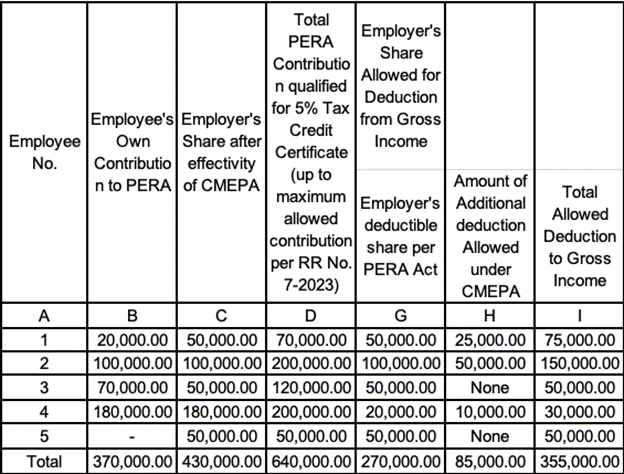
Pursuant to Sections 244 and 245 of the National Internal Revenue Code, in relation to Section 9 of Republic Act No. 12214 (Capital Markets Efficiency Promotion Act), Revenue Regulations No. 022-2025 further amends RR No. 17-2011 to allow private employers to deduct from gross income their qualified contributions to employees’ Personal Equity and Retirement Accounts (PERA) under RA No. 9505.
Revenue Regulations No. 024-2025

Sections 244 and 245 of the NIRC, RR No. 024-2025 imposes updated creditable withholding tax rates on income payments by top withholding agents to local suppliers of goods and services.

Standard Withholding Rates  Supplier of goods: One percent (1%)
Supplier of services: Two percent (2%)
New Reduced RateA rate of one-half percent (1/2%) is imposed for gross payments to manufacturers and direct importers of specific goods intended for wholesale.
Goods Subject to Reduced Rate    Motor vehicles in Completely Built Units (CBUs) or Semi-Knockdown (SKD) units, motor vehicle parts and accessories.
Medicine/pharmaceutical products
Solid or liquid fuels and related products.

REVENUE MEMORANDUM CIRCULAR

Revenue Memorandum Circular No. 084-2025

Pursuant to DOF Department Order No. 012-2025 and Revenue Memorandum Circular No. 084-2025, the Department of Finance issued a revised schedule of filing fees for applications for Tax Exemption Indorsements (TEIs) and non-TEIs to update the 25-year-old rates under DO No. 54-2000, ensuring alignment with current economic conditions and streamlining processing in accordance with the Ease of Doing Business Act. (Circularizing DOF Department Order No. 012-2025, Revenue Memorandum Circular No. 084-2025, September 9, 2025)

Value of ImportationFiling Fee
Php100,000.00 and belowPhp300.00
From Php100,000.01-Php400,000.00Php500.00
From Php400,000.01-Php600,000.00Php700.00
From Php600,000.01-Php800,000.00Php900.00
From Php800,000.01-Php1,000,000.00Php1,100.00
From Php1,000,000.01-Php5,000,000.00Php2,100.00
From Php5,000,000.01-Php10,000,000.00Php3,100.00
From Php10,000,000.01 and abovePhp4,100.00

Revenue Memorandum Circular No. 088-2025

Date IssuedOctober 1, 2025
SubjectBIR extends October 2025 tax deadlines to October 31 for Cebu earthquake-affected areas
Affected AreasFive Cebu-based RDOs namely: RDO No. 80-Mandaue City, CebuRDO No. 81-Cebu City NorthRDO No. 82-Cebu City SouthRDO No. 83-Talisay City, CebuRDO No. 123-Large Taxpayers Division-Cebu
ImpositionNo penalties, surcharges, or interest shall apply if compliance is made within the extended period.

BIR RULINGS

DONATION TO A RELIGIOUS CORPORATION IS EXEMPT FROM DONOR’S TAX. Donations made in favor of religious, charitable, and social welfare institutions, provided that not more than thirty percent (30%) of the donation is used for administrative purposes, are exempt from donor’s tax. Applying this, the Declaration of Heirship with Deed of Donation executed by the Donors in favor of a Religious Corporation, covering several parcels of land, qualifies for donor’s tax exemption. In accordance with Section 196 of the NIRC, the donation is also exempt from documentary stamp tax, except for the payment of ₱15.00 under Section 188 since it was made prior to the effectivity of the TRAIN Law. Accordingly, a Certificate of Tax Exemption was issued confirming such exemption. (Certificate of Tax Exemption No. DT-150-2025, DT-151-2025, April 25, 2025)

EXPORT SALES AND SERVICES PAID IN FOREIGN CURRENCY AND ACCOUNTED PER BSP RULES MAY BE SUBJECT TO 0% VAT, BUT NO RULING WAS ISSUED AS IT FALLS UNDER “NO-RULING AREAS.” Pursuant to Sections 106(A)(2)(a)(1) and 108(B)(2) of the National Internal Revenue Code (NIRC) of 1997, as amended, export sales of goods and services rendered to a non-resident foreign entity are subject to zero percent (0%) Value-Added Tax (VAT) when the consideration is paid in acceptable foreign currency and properly accounted for in accordance with Bangko Sentral ng Pilipinas (BSP) regulations. In this case, a VAT-registered domestic seller engaged in the sale of Uninterrupted Power Supply (UPS) units and related accessories entered into a transaction with a foreign buyer based outside the Philippines, with payment made in foreign currency and accounted per BSP rules, thus meeting the conditions for zero-rating under the law. However, the tax authority declined to issue a confirmatory opinion since the VAT treatment of export sales and services is classified as a “No-Ruling Area,” while emphasizing the seller’s obligation to comply with invoicing requirements under Section 113 of the NIRC, as amended by the Ease of Paying Taxes Act, including the proper labeling of sales as “zero-rated.” (BIR Ruling No. VAT-156-2025 April 25, 2025)


INCOME FROM SERVICES IS TAXABLE AND SUBJECT TO VAT IF THE INCOME-PRODUCING ACTIVITY IS PERFORMED WITHIN THE PHILIPPINES. Pursuant to Sections 23(F), 42(A)(3), and 108(A) of the National Internal Revenue Code (NIRC), a non-resident foreign entity is taxable only on income derived from sources within the Philippines, and services are considered sourced in the country if the income-generating activity or inflow of economic benefit occurs within Philippine territory. In this case, although the advertising services were carried out abroad, the income was derived from consumer activities and transactions within the Philippines resulting from such advertisements, showing that the income-producing activity was effectively performed locally. Accordingly, the service fees paid for these activities are subject to Philippine income tax, VAT, and applicable withholding tax. (BIR Ruling No. OT-168-2025, April 25, 2025)

SERVICES RENDERED ABROAD THAT GENERATE CUSTOMER LEADS AND ECONOMIC BENEFITS WITHIN THE PHILIPPINES ARE DEEMED PERFORMED LOCALLY AND ARE THEREFORE SUBJECT TO INCOME TAX, WITHHOLDING TAX, AND VAT. Pursuant to Sections 23(F), 42(A)(3), and 108(A) of the National Internal Revenue Code, income of a non-resident foreign corporation (NRFC) is taxable only if derived from sources within the Philippines, and services are considered sourced in the Philippines if performed therein. Applying this, the Bureau of Internal Revenue held that advertising and lead-generation services rendered abroad but resulting in customer engagement and economic benefits within the Philippines are deemed performed in the Philippines; thus, the related payments are subject to income tax, withholding tax, and VAT, as the income source and inflow of benefits occurred within Philippine territory. (BIR Ruling No. OT-169-2025, April 25, 2025)

PWDS ARE ENTITLED TO A 20% DISCOUNT AND VAT EXEMPTION ON SPECIFIED GOODS AND SERVICES, WHILE EMPLOYERS HIRING THEM MAY CLAIM AN ADDITIONAL 25% INCOME DEDUCTION. Pursuant to Republic Acts Nos. 9442 and 10754, which amend the Magna Carta for Persons with Disability (RA No. 7277), persons with disability (PWDs) are granted a 20% discount and exemption from the 12% value-added tax (VAT) on the purchase of specific goods and services such as medicines, medical and dental services, transportation, accommodations, and recreational activities, provided that a valid PWD ID is presented. While gainfully employed PWDs remain subject to income tax, employers hiring PWDs are entitled to an additional 25% deduction from gross income based on the salaries and wages paid to such employees. (BIR Ruling No. OT-170-2025, May 6, 2025)

MATERNITY LEAVE BENEFITS—INCLUDING SSS PAYMENTS AND EMPLOYER-PAID SALARY DIFFERENTIALS—ARE EXEMPT FROM INCOME AND WITHHOLDING TAXES FOR ELIGIBLE EMPLOYEES. Pursuant to Republic Act No. 11210 (Expanded Maternity Leave Law), Section 2.78.1(B)(1)(e) of Revenue Regulations No. 2-98, and Revenue Memorandum Circular No. 105-2019, maternity leave benefits consisting of the Social Security System (SSS) maternity benefit and the employer-paid salary differential are exempt from income and withholding taxes. In this case, the maternity benefits granted to employees of a government-owned or controlled corporation (GOCC) without a charter, duly registered with the SSS, fall within this exemption since the full pay during maternity leave is considered a benefit under the SSS law. (BIR Ruling No. OT-171-2025, May 6, 2025)

COMPENSATION FOR SUBTERRANEAN EASEMENT RIGHTS IS TREATED AS A TAXABLE TRANSFER OF REAL PROPERTY SUBJECT TO CGT OR FINAL INCOME TAX AND DST, THOUGH TITLE TRANSFER AND ECAR ISSUANCE ARE NOT REQUIRED. Pursuant to Sections 24(D)(1) and 196 of the National Internal Revenue Code (NIRC) of 1997, as amended, and Republic Act No. 10752, compensation received for the subterranean easement of right of way constitutes a transfer of real property subject to either capital gains tax (CGT) or final income tax at the taxpayer’s election, as the relinquishment of sub-terrain rights is deemed a disposition of real property under the law. Likewise, the transaction is subject to documentary stamp tax (DST) under Section 196 since it involves the conveyance of real property rights for consideration, although ownership of the surface land remains with the property owner. However, annotation of the easement on title may proceed without an eCAR since no actual transfer of ownership occurs. (BIR Ruling No. OT-173-2025, May 7, 2025)

THE PUBLIC AUCTION SALE OF GOVERNMENT-SEIZED ASSETS IS EXEMPT FROM CAPITAL GAINS TAX AND DOCUMENTARY STAMP TAX AS IT ARISES FROM THE EXERCISE OF ESSENTIAL GOVERNMENTAL FUNCTIONS. Pursuant to Section 32(B)(7)(b) of the National Internal Revenue Code of 1997, as amended, and Executive Orders Nos. 286 and 149, income derived by the government or its agencies from the exercise of essential governmental functions is exempt from income tax and related taxes. Since the sale of sequestered assets through public auction was conducted in the performance of the government’s mandate to dispose of forfeited properties, such a transaction is exempt from capital gains tax and documentary stamp tax in accordance with the statutory and executive exemptions granted to the Presidential Commission on Good Government (PCGG) as successor to the Sequestered Assets Disposition Authority (SADA). (BIR Ruling No. OT-174-2025, May 13, 2025)


INCOME DIRECTLY DERIVED FROM DULY REGISTERED BOI PROJECTS QUALIFIES FOR INCOME AND WITHHOLDING TAX EXEMPTION, WHILE NON-QUALIFYING OR EXCESS ACTIVITIES REMAIN SUBJECT TO REGULAR TAXATION. Entities registered with the Board of Investments (BOI) are granted exemption from income tax and creditable withholding tax on income directly attributable to their registered projects for a specified period. Accordingly, the certificates confirm tax exemption for revenues derived from BOI-registered activities, such as economic and low-cost housing projects and a petroleum distribution project, while maintaining that sales beyond the approved unit limits, commercial uses, or activities outside the registered scope remain taxable. (Certificate of Tax Exemption No. BOI-LEH-175-2025, BOI-LEH-176-2025, BOI-LEH-179-2025, May 15, 2025)

THE DONATION OF LAND TO A PUBLIC SCHOOL IS EXEMPT FROM DONOR’S TAX AND FROM DST, BEING A GIFT TO A GOVERNMENT ENTITY. Pursuant to Section 101(A)(2) of the National Internal Revenue Code of 1997, as amended, a donation made in favor of the government or any of its agencies is exempt from donor’s tax. Accordingly, the Deed of Donation executed by a local government unit in favor of a public educational institution over a parcel of land in Cabatuan, Iloilo qualifies for such exemption as it constitutes a gift to a government entity. The transaction is likewise not subject to documentary stamp tax (DST) under Section 196 of the Tax Code but is only liable to the DST imposed under Section 188 thereof. (Certificate of Tax Exemption No. DT-178-2025, May 15, 2025)

NPC-PAYOR IS RESPONSIBLE FOR WITHHOLDING AND REMITTING WITHHOLDING TAX COMPENSATION EVEN THOUGH PSALM ASSUMED NPC’S LIABILITY; HENCE, NPC’S TIN MUST BE USED FOR TAX REMITTANCE. Pursuant to Sections 2.57 and 2.57.3 of Revenue Regulations No. 2-98, as amended by RR No. 11-2018, the obligation to deduct, withhold, and remit withholding taxes rests upon the payor of income. In this case, although PSALM assumed the liabilities of the National Power Corporation (NPC) under the Electric Power Industry Reform Act (EPIRA), NPC acted as the processor and payor of the separation benefits due to its former employees. As confirmed by submitted documents and Board resolutions, NPC disbursed the payments, maintained access to employee records, and filed the related withholding tax returns; thus, the Bureau of Internal Revenue ruled that NPC’s Tax Identification Number (TIN) shall be used for remitting the taxes withheld on said separation benefits. (BIR Ruling No. OT-180-2025, May 29, 2025)

PROCEEDS FROM THE PRIVATIZATION OF A GOVERNMENT-OWNED POWER PLANT UNDER EPIRA ARE NOT SUBJECT TO INCOME TAX, WITHHOLDING TAX, OR VAT, AS THE TRANSACTION CONSTITUTES AN EXERCISE OF GOVERNMENTAL FUNCTION, NOT A COMMERCIAL ACTIVITY. Under Section 27(C) of the Tax Code, government-owned or controlled corporations (GOCCs) are generally subject to income tax only when engaged in commercial activities similar to those of private entities. However, Section 32(B)(7)(b) exempts income derived from the exercise of essential governmental functions, and Section 105 further limits VAT liability to transactions made in the course of trade or business. In this case, the sale of a hydroelectric power plant by two government entities to a private corporation was conducted under the mandate of the Electric Power Industry Reform Act (EPIRA) for the purpose of privatizing state-owned generation assets. Since this activity is legally recognized as a governmental function aimed at restructuring the energy sector and not a profit-driven business venture, the proceeds from the transaction are not subject to income tax, withholding tax, or VAT. (BIR Ruling No. OT-182-2025, June 10, 2025)

IMPORTATION OF LIQUEFIED NATURAL GAS (LNG) IS NOT SUBJECT TO EXCISE TAX AS THERE IS NO SPECIFIC PROVISION IMPOSING SUCH TAX ON IMPORTED LNG. Pursuant to Section 151(A)(2) of the Tax Code, as amended, excise tax is imposed only on specified mineral products, and it expressly exempts locally extracted natural gas and liquefied natural gas (LNG) from such tax. While this provision references local extraction, imported articles are subject to the same excise tax rules as their locally manufactured counterparts. Since LNG derived from locally extracted gas is tax-exempt and there is no separate provision for taxing imported LNG, the importation of LNG by a power-generating corporation for use in its Batangas-based plant is likewise not subject to excise tax. This interpretation is consistent with Revenue Regulations No. 8-96, relevant jurisprudence emphasizing strict construction against taxation, and the BIR's prior ATRIGs confirming the tax-exempt status of the corporation’s LNG imports. (BIR Ruling No.  OT-183-2025, July 29, 2025)

BIR DEADLINES FROM OCTOBER 20 TO OCTOBER 26, 2025. A gentle reminder on the following deadlines, as may be applicable:

DATEFILING/SUBMISSION
October 20, 2025SUBMISSION – Quarterly Information on OCWs or OFWs Remittances Exempt from DST furnished by the Local Banks & Non-Banks Money Transfer Agents. For the Quarter ending September 30, 2025.
 SUBMISSION – Quarterly Report of Printer. For the Quarter ending September 30, 2025
e-FILING/FILING & e-PAYMENT/PAYMENT – BIR Form 1600 WP (Remittance Return of Percentage Tax on Winnings and Prizes Withheld by Race Track Operators) – eFPS & Non-eFPS Filers. Month of September 2025
October 25, 2025SUBMISSION – Quarterly Summary List of Sales/Purchases/Importations by a VAT Registered Taxpayers - Non-eFPS Filers. For the Quarter ending September 30, 2025
SUBMISSION – Sworn Statement of Manufacturer’s or Importer’s Volume of Sales of each particular Brand of Alcohol Products, Tobacco Products and Sweetened Beverage Products. For the Quarter ending September 30, 2025
 e-FILING/FILING & e-PAYMENT/PAYMENT – BIR Form 2550Q (Quarterly Value-Added Tax Return) - eFPS & Non-eFPS Filers. For the Quarter ending September 30, 2025
e-FILING/FILING & e-PAYMENT/PAYMENT – BIR Form 2551Q (Quarterly Percentage Tax Return) – eFPS & Non-eFPS Filers. For the Quarter ending September 30, 2025

Show More

COURT OF TAX APPEALS (CTA) DECISIONS

ABSENCE OF A VALID LETTER OF AUTHORITY (LOA) BEFORE THE CONDUCT OF TAX AUDIT RENDERS THE ASSESSMENT VOID FOR VIOLATION OF DUE PROCESS. Jurisprudence consistently requires that a revenue officer’s authority to examine and assess a taxpayer must emanate from an LOA duly issued by the CIR or his authorized representative; otherwise, the resulting assessment is a nullity. In this case, the Bureau of Internal Revenue (BIR) relied only on a Letter Notice (LN), which cannot substitute for an LOA. The Court further found that the assessment lacked a factual basis, being founded merely on presumptions derived from computerized data matching without supporting evidence. Thus, the Court En Banc affirmed the First Division’s ruling that the assessment was void and unenforceable. (Commissioner of Internal Revenue v. Ermilo Tan Ng Hua, CTA EB No. 2734 [CTA Case No. 9912], 14 April 2025).

FAILURE TO PROPERLY SERVE THE FAN/FLD ON THE TAXPAYER OR ITS DULY AUTHORIZED REPRESENTATIVE RENDERS THE ASSESSMENT AND THE RESULTING WDL VOID FOR VIOLATION OF DUE PROCESS. Assessment notices must be duly served upon the taxpayer or its authorized representative to comply with due process. In this case, the Court found that the Bureau of Internal Revenue (BIR) failed to validly serve the Formal Assessment Notice (FAN) and Final Letter of Demand (FLD), as they were delivered to a different, unregistered address and received by a person merely identified as the “daughter” of one of the taxpayer’s officers, without proof of authority to accept official notices. Such service does not constitute valid substituted service. The Court ruled that the lack of proper service rendered the FAN/FLD void, and consequently, the Warrant of Distraint and Levy (WDL) issued pursuant thereto was likewise invalid for violation of the taxpayer’s right to due process. (Weltel Corporation v. Commissioner of Internal Revenue, CTA Case No. 10947, 30 April 2025).

ASSESSMENT ISSUED BEYOND THE THREE-YEAR PRESCRIPTIVE PERIOD IS VOID; THE BIR’S BELATED INVOCATION OF THE TEN-YEAR PERIOD WAS IMPROPER AS IT FAILED TO PROVE FRAUD OR FALSITY. The Court held that the BIR’s right to assess the taxpayer had been prescribed, as the assessment was issued more than three years after the filing of the 2011 tax return and beyond the extended period under the executed waiver. The BIR’s reliance on the ten-year extraordinary prescriptive period was unwarranted because it failed to establish with clear and convincing evidence that the return was false or fraudulent, as required by law. The assessment notices merely cited general references to under-declaration and did not present any factual basis or computation to substantiate fraud. Moreover, the use of a waiver indicated that the BIR itself recognized the application of the ordinary three-year period, making its later invocation of the ten-year period a mere afterthought. Consequently, the Court ruled that the assessment was void for having been issued beyond the prescriptive period and without due process, entitling the taxpayer to a refund of the garnished amount.(Weltel Corporation v. Commissioner of Internal Revenue, CTA Case No. 10947, 30 April 2025).

THE FAN IS VALID FOR CONTAINING A DEFINITE TAX LIABILITY AND DUE DATE AS POSSIBLE INTEREST ADJUSTMENTS DID NOT RENDER THE ASSESSMENT UNCERTAIN. The Court ruled that the Final Assessment Notice (FAN) issued to the taxpayer was valid and complied with due process requirements, as it clearly indicated both the specific amount of tax due and the corresponding payment deadline. This distinguishes the case from Commissioner of Internal Revenue v. Fitness by Design, Inc., where the assessment was void for lacking definite figures and dates. The Court clarified that the inclusion of a reminder about possible interest adjustments did not render the assessment uncertain, as the taxpayer was still clearly informed of the amount and due date of payment. (Quartz Business Products Corporation v. Commissioner of Internal Revenue, CTA Case No. 11096, 19 May 2025).

ASSESSMENT FOR ALLEGED UNACCOUNTED INCOME AND CORRESPONDING VAT WAS VOID FOR LACK OF FACTUAL AND LEGAL BASIS, AS NO ACTUAL INCOME OR SALE WAS PROVEN. The Court held that the deficiency income tax and VAT assessments based on alleged unaccounted income were without legal and factual foundation. Jurisprudence requires that income tax may only be imposed when there is actual or constructive receipt of income, representing a realized gain or profit. In this case, the Bureau of Internal Revenue (BIR) merely presumed undeclared income from the supposed discrepancy between the Summary List of Purchases (SLP) and the alphalist of payees, treating it as an “unaccounted source of cash.” The Court found such presumption insufficient, as there was no proof that petitioner derived any actual income or profit from the alleged unaccounted payments. Further, even assuming that undeclared purchases existed, such omission does not automatically constitute undeclared income, since taxpayers are not legally bound to claim all allowable deductions. With respect to VAT, the Court emphasized that VAT applies only to sales of goods or services where consideration is received, not to mere purchases or disbursements. As there was no showing that the petitioner sold any goods or services or received consideration therefore, the corresponding VAT assessment had no basis. Accordingly, both the deficiency income tax and VAT assessments arising from the alleged unaccounted income were properly cancelled. (Quartz Business Products Corporation v. Commissioner of Internal Revenue, CTA Case No. 11096, 19 May 2025).

EXCESS TAX CREDITS VALIDLY CARRIED OVER TO THE SUCCEEDING TAXABLE YEAR MAY BE RECAPTURED BY THE BIR, PROVIDED THE COMPUTATION REFLECTS THE CORRECT AMOUNT AS SHOWN IN THE TAXPAYER’S RETURN. The Court affirmed the validity of the BIR’s recapture of the taxpayer’s excess income tax credits carried over to the succeeding period, consistent with the rule on the irrevocability of the carry-over option. Once a corporation elects to carry over excess tax credits to the next taxable year, such choice becomes final and binding; the same credits may not thereafter be claimed as a refund or applied twice. In this case, the BIR correctly recognized the taxpayer’s election to carry over its excess tax credits but erred in the amount used for the adjustment. The Court emphasized that the recapture of excess tax credits does not invalidate the taxpayer’s carry-over election but rather enforces it by ensuring that credits are properly applied against future income tax liabilities. Allowing the taxpayer to again use the same excess credits without proof of their availability would result in double benefit and prejudice the government. Thus, while the BIR’s recapture was upheld, the assessment must be corrected to reflect the proper amount per the taxpayer’s ITR. (Quartz Business Products Corporation v. Commissioner of Internal Revenue, CTA Case No. 11096, 19 May 2025).

DEFICIENCY VAT ASSESSMENTS FOR PRESCRIBED PERIODS WERE DEEMED TIME-BARRED; HOWEVER, THE ENTIRE ASSESSMENT WAS SUSTAINED DUE TO THE TAXPAYER’S FAILURE TO PROVE WHICH PORTIONS PERTAINED TO THE PRESCRIBED MONTHS. The Court applied the general three-year prescriptive period for the assessment of internal revenue taxes, reckoned from the due date or actual filing of the quarterly VAT returns. Based on the filing and due dates, the BIR’s right to assess deficiency VAT for the first three quarters of taxable year (TY) 2011 had already been prescribed, while the assessment for the fourth quarter remained within the allowable period. However, the taxpayer failed to substantiate which portions of the assessed deficiency VAT corresponded to the prescribed quarters. The Court reiterated that tax assessments enjoy the presumption of correctness and regularity, and the burden rests upon the taxpayer to prove not only that the assessment is erroneous but also to specify the correct computation. Since the petitioner failed to present copies of its VAT returns or other documentary evidence showing when the taxable transactions occurred, the Court had no basis to segregate the prescribed and unprescribed portions. Consequently, the entire deficiency VAT assessment was deemed attributable to the unprescribed fourth quarter of TY 2011 and thus upheld as valid. (Quartz Business Products Corporation v. Commissioner of Internal Revenue, CTA Case No. 11096, 19 May 2025).

UNSUPPORTED VAT ZERO-RATED AND EXEMPT SALES WERE SUSTAINED DUE TO LACK OF SUBSTANTIATING EVIDENCE FROM THE TAXPAYER. The Court upheld the deficiency VAT assessments on the taxpayer’s alleged unsupported zero-rated sales and exempt sales. Under tax regulations, the entitlement to VAT zero-rating or exemption must be sufficiently established by competent evidence. Tax exemptions are strictly construed against the taxpayer and liberally in favor of the taxing authority, and the party claiming such exemption bears the burden of proving entitlement thereto. Applying this principle, the Court found that the petitioner neither presented documents nor raised arguments to substantiate its claim of zero-rated and exempt transactions in its Petition for Review or Memorandum. Absent any supporting evidence, the presumption of regularity and correctness of the tax assessment stands. Consequently, the deficiency VAT assessments corresponding to the alleged unsupported zero-rated and exempt sales were properly retained.  (Quartz Business Products Corporation v. Commissioner of Internal Revenue, CTA Case No. 11096, 19 May 2025).

A LETTER OF AUTHORITY (LOA) IS REQUIRED EVEN IN MANDATORY AUDITS CONDUCTED IN RELATION TO BUSINESS RETIREMENT APPLICATIONS. The Court held that the absence of a valid Letter of Authority (LOA) renders any tax assessment void, regardless of whether it arises from a regular assessment or a mandatory audit in connection with the retirement of business. Under the National Internal Revenue Code, only revenue officers duly authorized through an LOA may conduct an examination of a taxpayer’s books and records. The law does not distinguish between the types of assessments, and courts are bound not to create such distinctions. Applying this rule, the Court rejected the petitioner’s argument that a mandatory audit in relation to business closure does not require an LOA. The Court emphasized that the requirement of an LOA is grounded on the taxpayer’s right to due process, ensuring that the taxpayer is properly informed of the authorized officers conducting the audit. Hence, even in mandatory audits, a valid LOA remains an indispensable requirement for a lawful assessment. (Commissioner of Internal Revenue v. Sellery Phils. Enterprises, Inc., CTA EB No. 2837 [CTA Case No. 10049], 20 May 2025).

TAX ASSESSMENTS MUST CLEARLY STATE THE FACTUAL AND LEGAL BASES AND CONSIDER THE TAXPAYER’S REPLY; FAILURE TO DO SO VIOLATES DUE PROCESS AND RENDERS THE ASSESSMENT VOID. Under the National Internal Revenue Code and its implementing regulations, tax assessments must inform the taxpayer in writing of the factual and legal bases of the deficiency and must consider any reply to the Preliminary Assessment Notice; otherwise, the assessment is void for violation of due process. The Court of Tax Appeals found that the Bureau of Internal Revenue issued a Formal Letter of Demand and Final Assessment Notice identical to the Preliminary Assessment Notice, without addressing the taxpayer’s explanations or evidence submitted in its reply. This disregard of the taxpayer’s defenses and failure to provide specific reasons for rejecting them demonstrated noncompliance with due process requirements. The Court ruled that both the FLD/FAN and the subsequent Warrant of Distraint and/or Levy were void, emphasizing that while the government has authority to collect taxes, it must do so with fairness and strict adherence to the law. (Conveying and Packaging Co. Inc. v. Commissioner of Internal Revenue, CTA Case No. 10844, 26 May 2025)

UNDER THE NIRC, INPUT TAXES ATTRIBUTABLE TO VAT-EXEMPT TRANSACTIONS ARE NOT CREDITABLE; PETITIONER’S FAILURE TO PROPERLY ALLOCATE SUCH INPUT TAXES WARRANTS DISALLOWANCE. Pursuant to the NIRC and its implementing regulations, input taxes directly or proportionately attributable to VAT-exempt transactions cannot be credited against output VAT. In this case, the petitioner engaged in both taxable and exempt sales but failed to properly allocate the corresponding input taxes, resulting in the disallowance of input VAT. The Court of Tax Appeals held that such disallowance was justified, as the petitioner’s argument that its available input VAT could offset the deficiency was contrary to the rule against using excess input tax carry-overs to settle deficiency VAT. The Court emphasized that allowing such offset would lead to double benefit and administrative inefficiency, further citing the principle that taxes cannot be the subject of set-off or compensation since they are the lifeblood of the government. (National Reinsurance Corporation of the Philippines v. Commissioner of Internal Revenue, CTA Case No. 10791, Decision dated 4 June 2025).

TAX ASSESSMENTS ARE PRESUMED CORRECT, AND THE TAXPAYER BEARS THE BURDEN OF PROVING OTHERWISE; PETITIONER FAILED TO SUBSTANTIATE ITS CLAIM THAT IT HAD SUFFICIENT INPUT VAT TO OFFSET THE DISALLOWED AMOUNT.  Under the National Internal Revenue Code, a tax assessment issued by the Bureau of Internal Revenue is presumed correct, and the taxpayer has the burden to prove both that the assessment is erroneous and that its own computation is accurate. Here, the petitioner merely asserted that it had sufficient input VAT credits to offset its alleged deficiency but failed to present supporting evidence to disprove the respondent’s findings. The Court held that bare allegations cannot overcome the presumption of correctness of an assessment, and since the petitioner failed to discharge its burden of proof, the petition was denied for lack of merit. (National Reinsurance Corporation of the Philippines v. Commissioner of Internal Revenue, CTA Case No. 10791, Decision dated 4 June 2025).

UNDER THE LOCAL GOVERNMENT CODE, PAYMENT UNDER PROTEST IS NOT REQUIRED TO QUESTION A LOCAL BUSINESS TAX ASSESSMENT; THUS, THE PETITIONER’S PROTEST WAS VALID DESPITE NONPAYMENT OF THE ASSESSED AMOUNT. The CTA ruled that the validity of a protest or judicial action is not contingent upon prior payment. It further held that the local ordinance provision requiring payment before protest was void for being inconsistent with the Local Government Code. (Takenaka Corporation – Philippine Branch v. City of Makati and Hon. Jesusa E. Cuneta, CTA AC No. 307, 4  June 2025)

THE TAXPAYER BEARS THE BURDEN OF PROVING PAYMENT OF ASSESSED TAXES; PETITIONER FAILED TO SUBSTANTIATE ITS CLAIM OF PRIOR PAYMENT OF LOCAL BUSINESS TAXES WITH COMPETENT EVIDENCE. The Court held that financial statements, tax returns, business permits, and certifications from other local government units were insufficient to prove payment, emphasizing that receipts are the best evidence thereof.(Takenaka Corporation – Philippine Branch v. City of Makati and Hon. Jesusa E. Cuneta, CTA AC No. 307, 4  June 2025)

UNDER THE LOCAL GOVERNMENT CODE, A NOTICE OF ASSESSMENT MUST CLEARLY STATE THE FACTUAL AND LEGAL BASES OF THE TAX DEFICIENCY; FAILURE TO DO SO VIOLATES DUE PROCESS AND RENDERS THE ASSESSMENT VOID. The Local Government Code mandates that a notice of assessment must inform the taxpayer of the nature and basis of the tax deficiency to satisfy the requirements of due process. In this case, the City of Makati’s Notice of Assessment (NOA) against the taxpayer failed to indicate the specific statutory provision supporting the alleged local business tax (LBT) deficiency. Neither the NOA nor the subsequent demand letters provided clear factual or legal bases for the assessment, resulting in the taxpayer being deprived of the opportunity to intelligently protest or appeal the same. The Court held that such deficiency assessments, issued without proper notice of the law and facts relied upon, are null and void for violating the taxpayer’s right to due process. Moreover, the assessments for certain taxable years were also declared. Accordingly, the Court cancelled the assessments and enjoined the City of Makati from collecting the disputed amounts. (Takenaka Corporation – Philippine Branch v. City of Makati and Hon. Jesusa E. Cuneta, CTA AC No. 307, 4  June 2025)

TIMELY PAYMENT OF DOCKET FEES WITHIN FIVE DAYS FROM ELECTRONIC FILING SATISFIES THE CTA’S FILING REQUIREMENTS, EVEN IF THE COURT WAS CLOSED ON THE INITIAL FILING DATE.  The Court of Tax Appeals held that the petitioner duly complied with the payment of docket fees under the CTA’s En Banc Resolution on electronic filing, which allows payment and submission of proof within five (5) calendar days from the date of electronic filing. The petitioner attempted to file the Original Petition physically on November 5, 2021, but the Court had closed early for disinfection, prompting the petitioner to file via email on the same date. Since payment of the filing fees on November 5 was impossible due to the closure, the petitioner settled the docket fees and submitted the official receipts on November 8, 2021, within the prescribed five-day period. The Court ruled that such compliance was sufficient and that respondent’s claim of untimely payment lacked merit. (CIC Property Venture Holdings, Inc. v. Commissioner of Internal Revenue, CTA Case No. 10668, June 11, 2025)

DUE PROCESS IN TAX ASSESSMENTS — ASSESSMENT VOID FOR INDEFINITENESS OF DUE DATE AND FAILURE TO EXPLAIN REJECTION OF PROTEST.  The Court of Tax Appeals (CTA) held that the assessment issued by the Bureau of Internal Revenue (BIR) was void for violating due process, as the Formal Letter of Demand and Final Assessment Notice contained contradictory payment due dates, rendering the assessment indefinite, and because the BIR failed to clearly communicate the reasons for rejecting the taxpayer’s protest. Applying the due process standards established in Commissioner of Internal Revenue v. Avon Products Manufacturing, Inc., the Court ruled that such failures deprived the taxpayer of a meaningful opportunity to contest the assessment. Accordingly, the CTA denied the BIR’s Motion for Reconsideration and granted the taxpayer’s motion to amend the dispositive portion of its earlier decision to correctly refer to the taxable year 2017. (Kingston Aluminum and Stainless Sales Corp. v. Bureau of Internal Revenue–Revenue Region No. 9A, CTA Case No. 10326, Amended Decision, 17 June 2025). Where the BIR issued the FAN merely one day after the petitioner’s reply and without considering its contents, showing that the assessment was predetermined, such omission rendered the PAN, FAN, and Final Decision on Disputed Assessment null and void, as well as the Warrant of Distraint and/or Levy issued pursuant thereto. The Court emphasized that due process demands not only that a taxpayer be heard but that the BIR meaningfully consider the evidence presented. (CIC Property Venture Holdings, Inc. v. Commissioner of Internal Revenue, CTA Case No. 10668, June 11, 2025)

WARRANT OF DISTRAINT AND LEVY VOID FOR LACK OF VALID ASSESSMENT AND IMPROPER SERVICE. The Court of Tax Appeals ruled that the Warrant of Distraint and/or Levy (WDL) issued against Diageo Philippines, Inc. was void for having been based on an invalid assessment and for not being properly served. The CTA reiterated that a valid assessment is a substantive prerequisite for tax collection and that void assessments produce no legal effect. The WDL was also deemed improperly served, as it was merely left with a lobby receptionist who was neither an employee nor an authorized representative of the taxpayer, and no barangay official or disinterested witnesses were present to validate substituted service. Given these due process violations, the Court cancelled and set aside both the deficiency tax assessments and the resulting WDL, and enjoined the BIR from enforcing collection. (Diageo Philippines, Inc. v. Commissioner of Internal Revenue, CTA Case No. 10452, Decision, 19 June 2025)

ASSESSMENT IS VOID FOR LACK OF VALID LETTER OF AUTHORITY (LOA) TO CONDUCT AUDIT. The Court of Tax Appeals ruled that the deficiency tax assessment issued against Pro Star Sports Philippines, Inc. was void for having been conducted by revenue officers who were not armed with a valid Letter of Authority (LOA). The CTA emphasized that an LOA is a mandatory statutory requirement granting authority to revenue officers to examine a taxpayer’s books and issue assessments, and any audit conducted without such authority is a nullity. In this case, although an LOA was originally issued to other revenue officers, the subsequent reassignment of the audit to different officers was made through a mere Memorandum of Assignment without the issuance of a new or amended LOA, contrary to established rules and due process. Accordingly, the Court cancelled and set aside the deficiency income tax assessment and enjoined the BIR from collecting the assessed amount. (Pro Star Sports Philippines, Inc. v. Commissioner of Internal Revenue, CTA Case No. 11037, Decision, 24 June 2025); while the LOA named RO Tan and GS Hernandez, the audit and subsequent issuance of the assessment were instead conducted by RO Tan and GS Enriquez, who was not authorized under any LOA. The Court held that GS Enriquez’s unauthorized participation rendered the resulting deficiency tax assessment null and void, as an audit without proper authority violates due process and produces no valid tax liability. Consequently, the assessment, warrants, and garnishment were cancelled, and the BIR was ordered to refund the garnished amount to the taxpayer. (Brilliant Creations Publishing, Inc. v. Commissioner of Internal Revenue, CTA Case No. 11043, 20 June 2024)

TAX EXEMPTION OF COOPERATIVES ARISES FROM LAW, NOT FROM A BIR-ISSUED CERTIFICATE OF TAX EXEMPTION. Under the Philippine Cooperative Code, the grant of tax incentives and exemptions to duly registered cooperatives emanates directly from the law itself, not from any confirmatory issuance of the Bureau of Internal Revenue (BIR). The BIR’s Certificate of Tax Exemption merely serves as an administrative confirmation of the cooperative’s entitlement to exemptions already provided by statute and does not constitute the legal source of such privilege. Consequently, the absence or non-renewal of a Certificate of Tax Exemption does not automatically negate a cooperative’s tax-exempt status if it otherwise meets the legal requirements under the Code. In Commissioner of Internal Revenue v. Co, et al., G.R. No. 241424, February 26, 2020, the Supreme Court held that no prior confirmatory ruling is required for exemption or refund, as rulings merely operate to confirm conditions already existing under law. Applying the same principle, the Court ruled that the petitioner cooperative’s entitlement to exemption subsists by operation of law, and the BIR cannot deny such benefit solely for lack of a renewed Certificate of Tax Exemption. (CCT Multi-Purpose Cooperative [formerly CCT Credit Cooperative] v. Commissioner of Internal Revenue, CTA Case No. 10351, June 24, 2025)

COOPERATIVE EXEMPT FROM INCOME TAX BUT LIABLE FOR VAT, EWT, AND DST DUE TO TRANSACTIONS WITH NON-MEMBERS. Under the Philippine Cooperative Code, duly registered cooperatives that transact exclusively with their members are exempt from all internal revenue taxes, while those transacting with both members and non-members are exempt only on transactions with members, subject to income tax exemption granted to all cooperatives upon registration with the Cooperative Development Authority (CDA). In this case, the Court found that the petitioner cooperative failed to prove that it transacted solely with its members for taxable year 2016, as the Court-commissioned independent CPA confirmed that only 38% of its loan transactions were verified as member-related. Consequently, the cooperative was deemed to have dealt with non-members and was held liable for value-added tax (VAT), expanded withholding tax (EWT), and documentary stamp tax (DST). Nonetheless, since the cooperative was duly registered with the CDA and its registration remained valid, it was conclusively entitled to exemption from income tax under the law.(CCT Multi-Purpose Cooperative [formerly CCT Credit Cooperative] v. Commissioner of Internal Revenue, CTA Case No. 10351, June 24, 2025)

COOPERATIVE FAILED TO ESTABLISH ENTITLEMENT TO VAT AND EWT EXEMPTIONS, AND THE ASSESSMENTS WERE HELD VALID AND NOT PRESCRIBED. Under the Philippine Cooperative Code and its implementing rules, cooperatives with accumulated reserves exceeding PhP10,000,000.00 that transact with both members and non-members are subject to VAT and EWT on non-member transactions unless they prove compliance with statutory conditions for exemption, such as returning at least 25% of net income to members. In this case, the petitioner failed to substantiate that the VAT assessment pertained solely to transactions with members or that it complied with the income return requirement. It likewise failed to present evidence showing that the corresponding VAT and EWT returns were filed for taxable year 2016; hence, the Court applied the ten-year prescriptive period for assessment due to the presumed failure to file returns. Consequently, both the VAT and EWT assessments were upheld for lack of proof of exemption and prescription. (CCT Multi-Purpose Cooperative [formerly CCT Credit Cooperative] v. Commissioner of Internal Revenue, CTA Case No. 10351, 24 June  2025)

SECURITIES AND EXCHANGE COMMISSION

NUMBER OF DIRECTORS IN A FINANCING COMPANY (SEC-OGC OPINION NO. 24-37, NOVEMBER 19, 2024).. The Financing Company Act of 1998, as implemented by SEC Memorandum Circulars Nos. 5, 6, 14, and 16, financing companies—being stock corporations imbued with public interest—are generally required to have a Board of Directors composed of at least five (5) but not more than fifteen (15) members, with at least two (2) serving as independent directors. However, if the financing company qualifies as a close corporation and complies with the conditions under SEC MC No. 14, or if it does not possess the qualifications under SEC MC No. 5 that subject it to the Revised Code of Corporate Governance, it may operate with a minimum of two (2) regular directors. (Re: Number of Directors in a Financing Company, SEC-OGC Opinion No. 24-37, November 19, 2024.)

MANDATORY TENDER OFFER RULE (SEC-OGC OPINION NO. 24-38, NOVEMBER 26, 2024). Pursuant to the Securities Regulation Code (RA 8799) and its Implementing Rules and Regulations, as clarified in Cemco Holdings, Inc. v. National Life Insurance Co. of the Philippines, the mandatory tender offer rule applies to any transaction resulting in the acquisition of control or more than 50% of a public company’s outstanding equity, whether by cash subscription or debt-to-equity conversion. Thus, if a shareholder—such as Shareholder A—subscribes to additional unissued shares of Consolidated Mines, Inc. and thereby exceeds the 50% ownership threshold, a mandatory tender offer must be made to all remaining stockholders at a fair price supported by an independent fairness opinion. Failure of other stockholders to subscribe does not constitute waiver of their rights, and pre-emptive rights cannot be assigned to other shareholders. (Re: Mandatory Tender Offer Rule, SEC-OGC Opinion No. 24-38, November 26, 2024.)

RETAIL TRADE LIBERALIZATION ACT OF 2000, AS AMENDED (R.A. NO. 8762, AS AMENDED BY R.A. NO. 11595) – DEFINITION OF PAID-UP CAPITAL INCLUDES ADDITIONAL PAID-IN CAPITAL (APIC). Under the Retail Trade Liberalization Act (RTLA) and its Implementing Rules and Regulations, the term paid-up capital refers to the total investment paid into a corporation, which includes both par value and any additional paid-in capital or share premium. This interpretation aligns with the law’s liberal intent to attract foreign investments and promote market competitiveness by lowering barriers to entry in retail trade. Applying this to Electrolux Philippines, Inc., the Securities and Exchange Commission confirmed that its share premium or APIC should be included in determining compliance with the minimum paid-up capital requirement under the RTLA, as the premium forms part of the company’s total capital investment once infused. (Definition and Composition of Paid-Up Capital under the Retail Trade Liberalization Act of 2000, as Amended, SEC-OGC Opinion No. 24-39, November 26, 2024.)

BUY-BACK OF SHARES AFTER AUTOMATIC DELISTING (SEC-OGC OPINION NO. 24-40, DECEMBER 9, 2024). A corporation may reacquire its own shares provided it has unrestricted retained earnings and the buy-back serves a legitimate corporate purpose. Applying this to the case of PNOC Exploration Corporation (PNOC EC), which was involuntarily delisted from the Philippine Stock Exchange for non-compliance with the minimum public ownership requirement, the SEC held that PNOC EC may validly buy back its shares as long as these conditions are met. Considering that the shares subject to repurchase constitute only 0.21% of its total outstanding shares, the mandatory tender offer rules do not apply, although PNOC EC may choose to follow the tender offer procedures by analogy for transparency and fairness. (Re: Buy-Back of Shares After Automatic Delisting, SEC-OGC Opinion No. 24-40, December 9, 2024.)

MASS MEDIA AND ADVERTISING; FOREIGN OWNERSHIP RESTRICTIONS – ONLINE PLATFORM PROVIDING USER-GENERATED CONTENT IS NOT ENGAGED IN ADVERTISING (SEC-OGC OPINION NO. 24-41, DECEMBER 9, 2024). The SEC, interpreting these provisions alongside related laws such as R.A. No. 7394 (Consumer Act) and R.A. No. 9211 (Tobacco Regulation Act), reiterated that what characterizes a mass media entity is the dissemination of information or ideas to the public, not necessarily editorial control over content. Applying this principle, the Commission found that Pinoy Internet Ventures Online, Inc. (PIVOI), which operates a website allowing users to upload property listings and other user-generated content, is not engaged in mass media or advertising since it merely provides a digital platform and does not create, control, or disseminate content or advertising materials. However, the SEC emphasized that whether an online platform constitutes mass media depends on its use and extent of content dissemination. (Disini Law, Re: Entities Engaged in Mass Media and Advertising; Foreign Ownership Restrictions, SEC-OGC Opinion No. 24-41, December 9, 2024)

APPLICABILITY OF THE RULES ON MATERIAL RELATED PARTY TRANSACTIONS FOR PUBLICLY-LISTED COMPANIES (“MRPT”) (SEC-OGC OPINION NO. 24-42, DECEMBER 12, 2024). The regulation applies only to transactions between a reporting publicly-listed company (PLC) and its related parties to ensure transparency and prevent conflicts of interest. In SEC-OGC Opinion No. 24-42 (December 12, 2024), the SEC clarified that transactions by a subsidiary or affiliate of a PLC with a non-related party do not fall within the scope of the MRPT Rules, even if such subsidiary’s financials are consolidated with those of the parent PLC. Consolidation serves only for reporting and does not merge or disregard the distinct juridical personality of each entity. This principle is supported by Velarde v. Lopez, Inc., G.R. No. 153886 (January 14, 2004), which affirms the separate corporate personality of a subsidiary from its parent company.

SEC OPINION ON THE CAPACITY OF A FOREIGNER TO SIT AS PRESIDENT OF A FREIGHT FORWARDING CORPORATION. The SEC, citing the Revised Corporation Code and the Anti-Dummy Law, explained that while there is no express citizenship or residency requirement for a corporate president, foreigners are prohibited from managing or controlling corporations engaged in nationalized activities. The Commission examined PTO Air Express Corp.’s purpose of engaging in cargo and freight forwarding and, considering the amendments introduced by Republic Act No. 11659 to the Public Service Act, clarified that freight forwarding no longer constitutes a public utility activity restricted to Filipino citizens. Accordingly, a foreign national such as Ms. Kaikai Wu may lawfully serve as president of PTO Air Express Corp., provided that the company is not engaged in nationalized operations and remains compliant with other applicable laws and regulations. (SEC-OGC Opinion No. 25-01, Re: Capacity to Sit as President, February 10, 2025)

SEC OPINION ON THE AUTHORITY OF A FINANCING COMPANY TO INTRODUCE A NEW FINANCING PROGRAM UNDER ITS CORPORATE POWERS. Toyota Financial Services Philippines Corporation (TFSPC), being a duly registered financing company, may lawfully implement its proposed Lexus Financial Services (LFS) Program, as such activity is consistent with its primary purpose of financing and leasing motor vehicles under its Articles of Incorporation. Citing the Financing Company Act and jurisprudence, the Commission emphasized that a corporation possesses express and incidental powers necessary to fulfill its stated objectives, and acts performed within those limits are valid. However, since the LFS Program is a new product not yet reflected in TFSPC’s approved business plan, the company must first submit and secure approval of an amended plan before implementation. (SEC-OGC Opinion No. 25-05, Re: Implementation of New Financing Program; Corporate Powers; Purpose Clause, March 5, 2025)

PROHIBITION ON DIRECT LENDING BY CORPORATE DEBT VEHICLES (SEC-OGC OPINION NO. 25-06, MARCH 6, 2025). Under the Investment Company Act (ICA) and its Implementing Rules, as reinforced by SEC Memorandum Circular Nos. 23-20 and 33-20, Corporate Debt Vehicles (CDVs) are limited to investing in transferable securities and are expressly prohibited from engaging in direct lending of monies. In the case of Puyat Jacinto and Santos Law Office (for ATRAM Unitized Corporate Debt Vehicle, Inc.), the SEC clarified that investing in corporate debt securities such as bonds and notes does not equate to direct lending, as the former involves impersonal, market-based transactions distinct from a debtor-creditor relationship under a loan. Accordingly, the SEC ruled that ATRAM, as a CDV, cannot engage in direct lending activities. (SEC-OGC Opinion No. 25-06, “Prohibition on Direct Lending by Corporate Debt Vehicles,” March 6, 2025)

SEC CLARIFIES THAT ONLY DEPRECIATION ON REVALUATION INCREMENT MAY BE USED FOR DIVIDEND DECLARATION. The Securities and Exchange Commission (SEC) clarified that only the depreciation on the revaluation increment—and not the revaluation surplus itself—may be considered in determining the amount available for dividend declaration. In Opinion No. 25-08 (June 23, 2025), the SEC ruled that revaluation increments or appraisal surplus cannot be used directly as the basis for declaring dividends, as they do not represent actual earnings. However, when the depreciation on the appraisal increment has been charged to operations, that portion may be added back to retained earnings and made available for dividends, provided that (1) the company has sufficient operational income, (2) there is no deficit at the time the charge was made, and (3) the amount has not been impaired by subsequent losses.  (SEC-OGC Opinion No. 25-08, Re: Depreciation on Revaluation Increment Available for Dividend Declaration, June 23, 2025)

SEC CONFIRMS THAT REPRESENTATIVE OFFICES CANNOT ENGAGE IN INCOME-GENERATING ACTIVITIES. A representative office may conduct only non-income-generating activities such as information dissemination, product promotion, and quality control. It cannot import products for distribution or sale in the Philippines, as such activities constitute income-generating transactions that are beyond its allowed functions under the Revised Corporation Code and the Foreign Investments Act. In SEC-OGC Opinion No. 25-09 (June 24, 2025), the SEC clarified that a representative office, being an extension of its foreign parent company, does not have a separate legal personality and may only engage in activities such as information dissemination, product promotion, and quality control. While it may establish a physical office, employ personnel (including foreign nationals, subject to labor and immigration laws), and enter into lease contracts through its parent company, it is strictly prohibited from engaging in income-generating activities, including importing products for local distribution or sale. The SEC emphasized that importation for marketing or “market penetration” purposes that involves consideration or sale falls outside the permissible scope of a representative office’s functions.(SEC-OGC Opinion No. 25-09, Re: Limitations on Activities of Representative Offices, June 24, 2025)

SEC AFFIRMS THAT INCORPORATED JOINT VENTURES ARE GOVERNED BY THE REVISED CORPORATION CODE. Incorporated joint ventures (JVs) formed as domestic corporations are governed by the Revised Corporation Code of the Philippines (RCCP), not by the Civil Code provisions on partnerships, regardless of the parties’ contractual stipulations or choice of foreign law. The SEC held that when parties choose to form a joint venture as a corporation under Philippine law, such entity—referred to as an incorporated JV—is subject to the Revised Corporation Code and possesses a separate juridical personality distinct from its incorporators or shareholders. Even if the joint venture agreement provides that foreign law governs the arrangement or that the parties do not intend to form a partnership, the incorporated entity (Entity X) remains a Philippine domestic corporation bound by Philippine corporate law. The SEC emphasized that the shareholders’ agreement between the parties is valid only to the extent that it does not contravene mandatory provisions of the RCCP or public policy, reiterating that corporate laws take precedence over conflicting contractual terms.(SEC-OGC Opinion No. 25-12, Re: Governing Law Applicable to Incorporated Joint Ventures, July 14, 2025)

REVENUE REGULATIONS 

Revenue Regulations No. 022-2025

Pursuant to Sections 244 and 245 of the National Internal Revenue Code, in relation to Section 9 of Republic Act No. 12214 (Capital Markets Efficiency Promotion Act), Revenue Regulations No. 022-2025 further amends RR No. 17-2011 to allow private employers to deduct from gross income their qualified contributions to employees’ Personal Equity and Retirement Accounts (PERA) under RA No. 9505.

Revenue Regulations No. 024-2025

Sections 244 and 245 of the NIRC, RR No. 024-2025 imposes updated creditable withholding tax rates on income payments by top withholding agents to local suppliers of goods and services.

Standard Withholding Rates  Supplier of goods: One percent (1%)
Supplier of services: Two percent (2%)
New Reduced RateA rate of one-half percent (1/2%) is imposed for gross payments to manufacturers and direct importers of specific goods intended for wholesale.
Goods Subject to Reduced Rate    Motor vehicles in Completely Built Units (CBUs) or Semi-Knockdown (SKD) units, motor vehicle parts and accessories.
Medicine/pharmaceutical products
Solid or liquid fuels and related products.

REVENUE MEMORANDUM CIRCULAR

Revenue Memorandum Circular No. 084-2025

Pursuant to DOF Department Order No. 012-2025 and Revenue Memorandum Circular No. 084-2025, the Department of Finance issued a revised schedule of filing fees for applications for Tax Exemption Indorsements (TEIs) and non-TEIs to update the 25-year-old rates under DO No. 54-2000, ensuring alignment with current economic conditions and streamlining processing in accordance with the Ease of Doing Business Act. (Circularizing DOF Department Order No. 012-2025, Revenue Memorandum Circular No. 084-2025, September 9, 2025)

Value of ImportationFiling Fee
Php100,000.00 and belowPhp300.00
From Php100,000.01-Php400,000.00Php500.00
From Php400,000.01-Php600,000.00Php700.00
From Php600,000.01-Php800,000.00Php900.00
From Php800,000.01-Php1,000,000.00Php1,100.00
From Php1,000,000.01-Php5,000,000.00Php2,100.00
From Php5,000,000.01-Php10,000,000.00Php3,100.00
From Php10,000,000.01 and abovePhp4,100.00

Revenue Memorandum Circular No. 088-2025

Date IssuedOctober 1, 2025
SubjectBIR extends October 2025 tax deadlines to October 31 for Cebu earthquake-affected areas
Affected AreasFive Cebu-based RDOs namely: RDO No. 80-Mandaue City, CebuRDO No. 81-Cebu City NorthRDO No. 82-Cebu City SouthRDO No. 83-Talisay City, CebuRDO No. 123-Large Taxpayers Division-Cebu
ImpositionNo penalties, surcharges, or interest shall apply if compliance is made within the extended period.

BIR RULINGS

DONATION TO A RELIGIOUS CORPORATION IS EXEMPT FROM DONOR’S TAX. Donations made in favor of religious, charitable, and social welfare institutions, provided that not more than thirty percent (30%) of the donation is used for administrative purposes, are exempt from donor’s tax. Applying this, the Declaration of Heirship with Deed of Donation executed by the Donors in favor of a Religious Corporation, covering several parcels of land, qualifies for donor’s tax exemption. In accordance with Section 196 of the NIRC, the donation is also exempt from documentary stamp tax, except for the payment of ₱15.00 under Section 188 since it was made prior to the effectivity of the TRAIN Law. Accordingly, a Certificate of Tax Exemption was issued confirming such exemption. (Certificate of Tax Exemption No. DT-150-2025, DT-151-2025, April 25, 2025)

EXPORT SALES AND SERVICES PAID IN FOREIGN CURRENCY AND ACCOUNTED PER BSP RULES MAY BE SUBJECT TO 0% VAT, BUT NO RULING WAS ISSUED AS IT FALLS UNDER “NO-RULING AREAS.” Pursuant to Sections 106(A)(2)(a)(1) and 108(B)(2) of the National Internal Revenue Code (NIRC) of 1997, as amended, export sales of goods and services rendered to a non-resident foreign entity are subject to zero percent (0%) Value-Added Tax (VAT) when the consideration is paid in acceptable foreign currency and properly accounted for in accordance with Bangko Sentral ng Pilipinas (BSP) regulations. In this case, a VAT-registered domestic seller engaged in the sale of Uninterrupted Power Supply (UPS) units and related accessories entered into a transaction with a foreign buyer based outside the Philippines, with payment made in foreign currency and accounted per BSP rules, thus meeting the conditions for zero-rating under the law. However, the tax authority declined to issue a confirmatory opinion since the VAT treatment of export sales and services is classified as a “No-Ruling Area,” while emphasizing the seller’s obligation to comply with invoicing requirements under Section 113 of the NIRC, as amended by the Ease of Paying Taxes Act, including the proper labeling of sales as “zero-rated.” (BIR Ruling No. VAT-156-2025 April 25, 2025)


INCOME FROM SERVICES IS TAXABLE AND SUBJECT TO VAT IF THE INCOME-PRODUCING ACTIVITY IS PERFORMED WITHIN THE PHILIPPINES. Pursuant to Sections 23(F), 42(A)(3), and 108(A) of the National Internal Revenue Code (NIRC), a non-resident foreign entity is taxable only on income derived from sources within the Philippines, and services are considered sourced in the country if the income-generating activity or inflow of economic benefit occurs within Philippine territory. In this case, although the advertising services were carried out abroad, the income was derived from consumer activities and transactions within the Philippines resulting from such advertisements, showing that the income-producing activity was effectively performed locally. Accordingly, the service fees paid for these activities are subject to Philippine income tax, VAT, and applicable withholding tax. (BIR Ruling No. OT-168-2025, April 25, 2025)

SERVICES RENDERED ABROAD THAT GENERATE CUSTOMER LEADS AND ECONOMIC BENEFITS WITHIN THE PHILIPPINES ARE DEEMED PERFORMED LOCALLY AND ARE THEREFORE SUBJECT TO INCOME TAX, WITHHOLDING TAX, AND VAT. Pursuant to Sections 23(F), 42(A)(3), and 108(A) of the National Internal Revenue Code, income of a non-resident foreign corporation (NRFC) is taxable only if derived from sources within the Philippines, and services are considered sourced in the Philippines if performed therein. Applying this, the Bureau of Internal Revenue held that advertising and lead-generation services rendered abroad but resulting in customer engagement and economic benefits within the Philippines are deemed performed in the Philippines; thus, the related payments are subject to income tax, withholding tax, and VAT, as the income source and inflow of benefits occurred within Philippine territory. (BIR Ruling No. OT-169-2025, April 25, 2025)

PWDS ARE ENTITLED TO A 20% DISCOUNT AND VAT EXEMPTION ON SPECIFIED GOODS AND SERVICES, WHILE EMPLOYERS HIRING THEM MAY CLAIM AN ADDITIONAL 25% INCOME DEDUCTION. Pursuant to Republic Acts Nos. 9442 and 10754, which amend the Magna Carta for Persons with Disability (RA No. 7277), persons with disability (PWDs) are granted a 20% discount and exemption from the 12% value-added tax (VAT) on the purchase of specific goods and services such as medicines, medical and dental services, transportation, accommodations, and recreational activities, provided that a valid PWD ID is presented. While gainfully employed PWDs remain subject to income tax, employers hiring PWDs are entitled to an additional 25% deduction from gross income based on the salaries and wages paid to such employees. (BIR Ruling No. OT-170-2025, May 6, 2025)

MATERNITY LEAVE BENEFITS—INCLUDING SSS PAYMENTS AND EMPLOYER-PAID SALARY DIFFERENTIALS—ARE EXEMPT FROM INCOME AND WITHHOLDING TAXES FOR ELIGIBLE EMPLOYEES. Pursuant to Republic Act No. 11210 (Expanded Maternity Leave Law), Section 2.78.1(B)(1)(e) of Revenue Regulations No. 2-98, and Revenue Memorandum Circular No. 105-2019, maternity leave benefits consisting of the Social Security System (SSS) maternity benefit and the employer-paid salary differential are exempt from income and withholding taxes. In this case, the maternity benefits granted to employees of a government-owned or controlled corporation (GOCC) without a charter, duly registered with the SSS, fall within this exemption since the full pay during maternity leave is considered a benefit under the SSS law. (BIR Ruling No. OT-171-2025, May 6, 2025)

COMPENSATION FOR SUBTERRANEAN EASEMENT RIGHTS IS TREATED AS A TAXABLE TRANSFER OF REAL PROPERTY SUBJECT TO CGT OR FINAL INCOME TAX AND DST, THOUGH TITLE TRANSFER AND ECAR ISSUANCE ARE NOT REQUIRED. Pursuant to Sections 24(D)(1) and 196 of the National Internal Revenue Code (NIRC) of 1997, as amended, and Republic Act No. 10752, compensation received for the subterranean easement of right of way constitutes a transfer of real property subject to either capital gains tax (CGT) or final income tax at the taxpayer’s election, as the relinquishment of sub-terrain rights is deemed a disposition of real property under the law. Likewise, the transaction is subject to documentary stamp tax (DST) under Section 196 since it involves the conveyance of real property rights for consideration, although ownership of the surface land remains with the property owner. However, annotation of the easement on title may proceed without an eCAR since no actual transfer of ownership occurs. (BIR Ruling No. OT-173-2025, May 7, 2025)

THE PUBLIC AUCTION SALE OF GOVERNMENT-SEIZED ASSETS IS EXEMPT FROM CAPITAL GAINS TAX AND DOCUMENTARY STAMP TAX AS IT ARISES FROM THE EXERCISE OF ESSENTIAL GOVERNMENTAL FUNCTIONS. Pursuant to Section 32(B)(7)(b) of the National Internal Revenue Code of 1997, as amended, and Executive Orders Nos. 286 and 149, income derived by the government or its agencies from the exercise of essential governmental functions is exempt from income tax and related taxes. Since the sale of sequestered assets through public auction was conducted in the performance of the government’s mandate to dispose of forfeited properties, such a transaction is exempt from capital gains tax and documentary stamp tax in accordance with the statutory and executive exemptions granted to the Presidential Commission on Good Government (PCGG) as successor to the Sequestered Assets Disposition Authority (SADA). (BIR Ruling No. OT-174-2025, May 13, 2025)


INCOME DIRECTLY DERIVED FROM DULY REGISTERED BOI PROJECTS QUALIFIES FOR INCOME AND WITHHOLDING TAX EXEMPTION, WHILE NON-QUALIFYING OR EXCESS ACTIVITIES REMAIN SUBJECT TO REGULAR TAXATION. Entities registered with the Board of Investments (BOI) are granted exemption from income tax and creditable withholding tax on income directly attributable to their registered projects for a specified period. Accordingly, the certificates confirm tax exemption for revenues derived from BOI-registered activities, such as economic and low-cost housing projects and a petroleum distribution project, while maintaining that sales beyond the approved unit limits, commercial uses, or activities outside the registered scope remain taxable. (Certificate of Tax Exemption No. BOI-LEH-175-2025, BOI-LEH-176-2025, BOI-LEH-179-2025, May 15, 2025)

THE DONATION OF LAND TO A PUBLIC SCHOOL IS EXEMPT FROM DONOR’S TAX AND FROM DST, BEING A GIFT TO A GOVERNMENT ENTITY. Pursuant to Section 101(A)(2) of the National Internal Revenue Code of 1997, as amended, a donation made in favor of the government or any of its agencies is exempt from donor’s tax. Accordingly, the Deed of Donation executed by a local government unit in favor of a public educational institution over a parcel of land in Cabatuan, Iloilo qualifies for such exemption as it constitutes a gift to a government entity. The transaction is likewise not subject to documentary stamp tax (DST) under Section 196 of the Tax Code but is only liable to the DST imposed under Section 188 thereof. (Certificate of Tax Exemption No. DT-178-2025, May 15, 2025)

NPC-PAYOR IS RESPONSIBLE FOR WITHHOLDING AND REMITTING WITHHOLDING TAX COMPENSATION EVEN THOUGH PSALM ASSUMED NPC’S LIABILITY; HENCE, NPC’S TIN MUST BE USED FOR TAX REMITTANCE. Pursuant to Sections 2.57 and 2.57.3 of Revenue Regulations No. 2-98, as amended by RR No. 11-2018, the obligation to deduct, withhold, and remit withholding taxes rests upon the payor of income. In this case, although PSALM assumed the liabilities of the National Power Corporation (NPC) under the Electric Power Industry Reform Act (EPIRA), NPC acted as the processor and payor of the separation benefits due to its former employees. As confirmed by submitted documents and Board resolutions, NPC disbursed the payments, maintained access to employee records, and filed the related withholding tax returns; thus, the Bureau of Internal Revenue ruled that NPC’s Tax Identification Number (TIN) shall be used for remitting the taxes withheld on said separation benefits. (BIR Ruling No. OT-180-2025, May 29, 2025)

PROCEEDS FROM THE PRIVATIZATION OF A GOVERNMENT-OWNED POWER PLANT UNDER EPIRA ARE NOT SUBJECT TO INCOME TAX, WITHHOLDING TAX, OR VAT, AS THE TRANSACTION CONSTITUTES AN EXERCISE OF GOVERNMENTAL FUNCTION, NOT A COMMERCIAL ACTIVITY. Under Section 27(C) of the Tax Code, government-owned or controlled corporations (GOCCs) are generally subject to income tax only when engaged in commercial activities similar to those of private entities. However, Section 32(B)(7)(b) exempts income derived from the exercise of essential governmental functions, and Section 105 further limits VAT liability to transactions made in the course of trade or business. In this case, the sale of a hydroelectric power plant by two government entities to a private corporation was conducted under the mandate of the Electric Power Industry Reform Act (EPIRA) for the purpose of privatizing state-owned generation assets. Since this activity is legally recognized as a governmental function aimed at restructuring the energy sector and not a profit-driven business venture, the proceeds from the transaction are not subject to income tax, withholding tax, or VAT. (BIR Ruling No. OT-182-2025, June 10, 2025)

IMPORTATION OF LIQUEFIED NATURAL GAS (LNG) IS NOT SUBJECT TO EXCISE TAX AS THERE IS NO SPECIFIC PROVISION IMPOSING SUCH TAX ON IMPORTED LNG. Pursuant to Section 151(A)(2) of the Tax Code, as amended, excise tax is imposed only on specified mineral products, and it expressly exempts locally extracted natural gas and liquefied natural gas (LNG) from such tax. While this provision references local extraction, imported articles are subject to the same excise tax rules as their locally manufactured counterparts. Since LNG derived from locally extracted gas is tax-exempt and there is no separate provision for taxing imported LNG, the importation of LNG by a power-generating corporation for use in its Batangas-based plant is likewise not subject to excise tax. This interpretation is consistent with Revenue Regulations No. 8-96, relevant jurisprudence emphasizing strict construction against taxation, and the BIR’s prior ATRIGs confirming the tax-exempt status of the corporation’s LNG imports. (BIR Ruling No.  OT-183-2025, July 29, 2025)

BIR DEADLINES FROM OCTOBER 20 TO OCTOBER 26, 2025. A gentle reminder on the following deadlines, as may be applicable:

DATEFILING/SUBMISSION
October 20, 2025SUBMISSION – Quarterly Information on OCWs or OFWs Remittances Exempt from DST furnished by the Local Banks & Non-Banks Money Transfer Agents. For the Quarter ending September 30, 2025.
 SUBMISSION – Quarterly Report of Printer. For the Quarter ending September 30, 2025
e-FILING/FILING & e-PAYMENT/PAYMENT – BIR Form 1600 WP (Remittance Return of Percentage Tax on Winnings and Prizes Withheld by Race Track Operators) – eFPS & Non-eFPS Filers. Month of September 2025
October 25, 2025SUBMISSION – Quarterly Summary List of Sales/Purchases/Importations by a VAT Registered Taxpayers – Non-eFPS Filers. For the Quarter ending September 30, 2025
SUBMISSION – Sworn Statement of Manufacturer’s or Importer’s Volume of Sales of each particular Brand of Alcohol Products, Tobacco Products and Sweetened Beverage Products. For the Quarter ending September 30, 2025
 e-FILING/FILING & e-PAYMENT/PAYMENT – BIR Form 2550Q (Quarterly Value-Added Tax Return) – eFPS & Non-eFPS Filers. For the Quarter ending September 30, 2025
e-FILING/FILING & e-PAYMENT/PAYMENT – BIR Form 2551Q (Quarterly Percentage Tax Return) – eFPS & Non-eFPS Filers. For the Quarter ending September 30, 2025
Show More

Thank You for Making This Possible.

October 15, 2025

Dear Clients, Colleagues, and Friends,

We are pleased to share that our firm has been named a finalist at the Asian Legal Business (ALB) Philippine Law Awards 2025 held at the Shangri-la Fort Taguig, BGC last October 8, in the following categories:

  • Tax and Trusts Law Firm of the Year
  • Boutique Law Firm of the Year
  • Rising Law Firm of the Year
  • Managing Partner of the Year – Atty. Rhondee E. Dumlao, CPA

This recognition is truly your achievement as well as our partner. We owe this milestone to your continued trust, support, and the opportunities you have given us to serve you.

We are also deeply grateful to those who took the time to nominate our firm; your confidence inspires us to keep striving for excellence and to deliver the highest quality of legal service.

As we celebrate this honor, we look forward to working with you on more meaningful projects and partnerships ahead.

Warm regards,

Dumlao & Co.

Show More

Dear Clients, Colleagues, and Friends,

We are pleased to share that our firm has been named a finalist at the Asian Legal Business (ALB) Philippine Law Awards 2025 held at the Shangri-la Fort Taguig, BGC last October 8, in the following categories:

  • Tax and Trusts Law Firm of the Year
  • Boutique Law Firm of the Year
  • Rising Law Firm of the Year
  • Managing Partner of the Year – Atty. Rhondee E. Dumlao, CPA

This recognition is truly your achievement as well as our partner. We owe this milestone to your continued trust, support, and the opportunities you have given us to serve you.

We are also deeply grateful to those who took the time to nominate our firm; your confidence inspires us to keep striving for excellence and to deliver the highest quality of legal service.

As we celebrate this honor, we look forward to working with you on more meaningful projects and partnerships ahead.

Warm regards,

Dumlao & Co.

Show More

October 2 2025 Tax Updates

October 3, 2025

COURT OF TAX APPEALS (CTA) DECISIONS

AN ASSESSMENT ISSUED WITHOUT A VALID LETTER OF AUTHORITY AND WITHOUT DUE CONSIDERATION OF THE TAXPAYER’S DEFENSES IS VOID AB INITIO. The Court of Tax Appeals ruled that the Formal Letter of Demand (FLD) issued against Zambales Diversified Metals Corporation was void ab initio for violation of due process. Jurisprudence consistently requires a valid Letter of Authority (LOA) before revenue officers may conduct an audit, and any reassignment without issuance of a new LOA renders the audit and resulting assessment invalid. In this case, the audit was conducted by officers not named in the LOA, and further, the FLD was a mere verbatim reproduction of the Preliminary Assessment Notice without addressing the taxpayer’s reply or defenses, effectively depriving petitioner of its right to due process. Accordingly, the Court cancelled the assessment of deficiency taxes amounting to PhP 1.86 billion for taxable year 2014.(Zambales Diversified Metals Corporation v. Commissioner of Internal Revenue, CTA Case No. 10783, 7 April 2025).

A TAX ASSESSMENT IS VOID WHEN CONDUCTED BY REVENUE OFFICERS NOT COVERED BY A VALID LETTER OF AUTHORITY (LOA), AS A MEMORANDUM OF ASSIGNMENT (MOA) CANNOT SUBSTITUTE THE STATUTORY REQUIREMENT OF AN LOA. Jurisprudence is settled that the authority of a revenue officer to examine a taxpayer’s books flows exclusively from a validly issued Letter of Authority (LOA). A Memorandum of Assignment (MOA), Referral Memorandum, or similar internal document merely reassigns cases within the Bureau of Internal Revenue but cannot vest authority to audit. Otherwise, such practice usurps the statutory power of the Commissioner of Internal Revenue or his duly authorized representative. In this case, the audit of petitioner Schema Konsult, Inc. for taxable year 2013 was originally covered by an LOA issued to specific revenue officers. However, when those officers were reassigned, Revenue District Officer Emilia Combes issued a MOA designating other officers to continue the audit without the issuance of a new LOA in their names. These substitute officers, therefore, lacked valid authority to examine the petitioner's books. Since the audit was conducted without a valid LOA, the resulting Preliminary Assessment Notice, Final Assessment Notice, and Formal Letter of Demand are void. Consequently, the Warrant of Distraint and/or Levy issued to enforce the assessments must likewise be cancelled. (Schema Konsult, Inc. v. Commissioner of Internal Revenue, CTA Case No. 10041, 3 April 2025).

A WAIVER UNDER RMO NO. 14-2016 WITH EXECUTION AND EXPIRY DATES VALIDLY EXTENDED THE BIR’S PERIOD TO ASSESS, BUT THE DEFICIENCY VAT ASSESSMENT WAS CANCELLED FOR LACK OF BASIS IN DISALLOWING INPUT TAX AND DENYING VAT ZERO-RATING ON ECOZONE SALES. Under RMO No. 14-2016, a waiver of the statute of limitations is valid so long as it contains the date of execution and the expiry date, without need of acceptance by the BIR. In this case, the waiver executed on May 7, 2021 validly extended the BIR’s period to assess until November 15, 2021, rendering the FLD issued on June 14, 2021 timely. The Court also found that the revenue officers who issued the FLD were duly authorized under a valid LOA. However, the assessment was fatally defective because the BIR disallowed petitioner’s carried-over input tax without citing any factual or legal basis and erroneously denied VAT zero-rating on sales to PEZA and SBMA-registered entities, contrary to law and jurisprudence. Since the taxpayer’s allowable input tax exceeded its output tax, the recomputation showed an overpayment rather than a deficiency, thereby cancelling the assessment.  (Ford Group Philippines, Inc. v. Commissioner of Internal Revenue, CTA Case No. 10805, 4 April 2025).

ASSESSMENT AND WARRANT OF DISTRAINT AND/OR LEVY ARE VOID FOR BEING BASED ON MERE PRESUMPTIONS, LACKING DUE PROCESS. The CTA ruled that to properly resolve the validity of the Warrant of Distraint and/or Levy (WDL), it had to examine the underlying assessments, which were null and void because they were founded on unverified third-party information and not personally served to the taxpayer or its authorized representative, thereby failing due process. Testimonial evidence confirmed that the taxpayer had no transactions with the third party during the relevant period, and the BIR did not properly substantiate the assessments. As such, the WDL issued pursuant to these defective assessments was likewise invalid. The CTA En Banc affirmed the Division’s decision denying the Commissioner’s petition. (Commissioner of Internal Revenue v. Julio R. De Quinto, CTA EB No. 2830, 22 April 2025).

ELECTRIC COOPERATIVES REGISTERED WITH THE NEA ARE PERMANENTLY EXEMPT FROM INCOME TAX. Electric cooperatives duly registered with the NEA enjoy permanent income tax exemption under existing law, and such exemption remains valid despite withdrawals or modifications by subsequent laws or executive issuances that are inconsistent with this provision. In this case, petitioner Pampanga I Electric Cooperative, Inc., being registered with the NEA, is entitled to permanent income tax exemption, and thus the deficiency income tax assessment and related notices issued against it are null and void. (Pampanga I Electric Cooperative, Inc. v. Commissioner of Internal Revenue, CTA Case No. 10961, April 23, 2025).

MARKET FEES COLLECTED BY WESM MEMBERS TO COVER OPERATIONAL COSTS ARE NOT SUBJECT TO INCOME TAX. A market operator is allowed to recover costs of administering and operating the Wholesale Electricity Spot Market (WESM) through charges imposed on WESM members. Since these market fees are intended solely to cover operational costs and are collected on a non-profit basis, they do not constitute gain or profit to the Market Operator and therefore do not qualify as taxable income. Accordingly, such fees are not subject to income or withholding tax. (Independent Electricity Market Operator of the Philippines, Inc. v. Commissioner of Internal Revenue & Secretary of Finance, CTA Case No. 10885, 5 May 2025).

NET SETTLEMENT SURPLUS (NSS) IS NOT SUBJECT TO INCOME TAX AS IT DOES NOT CONSTITUTE GAIN OR PROFIT. Income is taxable only if there is a realized gain or profit. NSS represents the reconciliation of amounts payable to sellers and receivable from buyers in the Wholesale Electricity Spot Market and arises from locational pricing and congestion differences. The ERC Resolutions governing NSS distribution ensure that neither the Market Operator nor its successor realizes actual gain or profit from NSS, as surpluses are flowed back or allocated to market participants. Consequently, NSS does not constitute taxable income. (Independent Electricity Market Operator of the Philippines, Inc. v. Commissioner of Internal Revenue & Secretary of Finance, CTA Case No. 10885, 5 May 2025).

ASSESSMENT BEYOND THE PRESCRIPTIVE PERIOD IS VOID EVEN IF DEFICIENCY NOTICES ARE ISSUED. Under Sections 203 and 222(a) of the NIRC of 1997, internal revenue taxes must generally be assessed within three years from filing of the return, with an extraordinary 10-year period allowed only for false or fraudulent returns with intent to evade tax. Mere errors or unintentional misstatements do not justify the 10-year period, and the BIR bears the burden of proving such intent with clear and convincing evidence. In this case, petitioner filed its 2011 return in April 2012, and although a waiver was executed extending the three-year period until December 31, 2015, the assessment notices were issued only in December 2020, well beyond the prescriptive period. The BIR failed to establish that the return was false or fraudulent, and the notices did not provide sufficient factual basis for assessment, depriving the petitioner of due process. Accordingly, the assessment is void. (Welte! Corporation v. Commissioner of Internal Revenue, CTA Case No. 10947, May 5, 2025).

SECURITIES AND EXCHANGE COMMISSION

SEC CLARIFIES NON-APPLICABILITY OF SRC REGISTRATION TO FREE DISTRIBUTION OF TIMESHARE EXCHANGE PROGRAM DOCUMENTS. The Securities Regulation Code requires registration only when securities are sold or offered for sale within the Philippines. Applying this to Marriott Ownership Resorts, Inc.’s (MORI) Marriot Vacation Club Destinations Exchange Program (MVCD-EP), the SEC held that the program does not constitute a sale or offer of securities since no monetary consideration is involved, and the distribution merely provides a free upgrade to existing timeshare owners, whose timeshares were not originally sold in the Philippines. Thus, registration under the SRC is unnecessary. (Applicability of SRC Registration Requirements to Timeshares, SEC-OGC Opinion No. 24-04, March 26, 2024).

SEC RULES THAT LGEPH MUST AMEND ARTICLES OF INCORPORATION TO INCLUDE BPO SERVICES UNDER SECONDARY PURPOSES. In resolving LG Electronics Philippines, Inc. 's (LGEPH) query, the SEC ruled that a corporation may only exercise powers expressly stated in its Articles of Incorporation or those reasonably incidental to its primary purpose under the Revised Corporation Code. Since BPO operations are neither expressly authorized nor incidental to LGEPH’s primary purpose as a wholesaler and distributor of electrical products, such activities cannot be undertaken without an amendment. The proper approach is to add BPO services under its secondary purposes, as a primary purpose amendment cannot cover unrelated or distinct business activities. (Amendment of Primary Purpose to Include Business Process Outsourcing (BPO) Services, SEC-OGC Opinion No. 24-05, April 2, 2024).

SEC ALLOWS LIQUIDATION BEYOND 3-YEAR WINDING UP PERIOD WITH DIRECTORS AS TRUSTEES. Under the Revised Corporation Code, a dissolved corporation retains a limited three-year existence to settle its affairs, dispose of property, and distribute assets. However, jurisprudence and SEC rulings recognize that liquidation may continue beyond this period through a receiver, trustee, or by the board of directors acting as trustees by legal implication. Applying this to L. Aznar-Alfonzo Realty and Holdings Corporation, whose registration was revoked in 2004, the SEC confirmed that it may still liquidate its remaining investment in Southwestern University-PHINMA despite the lapse of the winding-up period. (Liquidation Beyond the 3-Year Winding Up Period, SEC-OGC Opinion No. 24-06, April 4, 2024).

SEC CONFIRMS FLEXIBILITY ON BOARD COMPOSITION AND NON-RESIDENCY REQUIREMENT UNDER RCCP. The SEC clarified that the Revised Corporation Code (RCCP) removed the old residency requirement for directors, thus corporations may elect non-resident directors unless their bylaws expressly require otherwise. In Oracle (Philippines) Corporation’s case, its Articles of Incorporation and bylaws impose no such restriction, allowing the election of a majority or even all non-resident directors. The SEC likewise confirmed that corporations may fix the number of directors at fewer than five, since the RCCP did not reproduce the minimum limit under the old Corporation Code. Thus, Oracle may lawfully amend its Articles of Incorporation to provide for a three-or four-member board, subject to approval by the SEC. (Re: Section 22 of Republic Act No. 11232 or the Revised Corporation Code of the Philippines (RCCP), SEC-OGC Opinion No. 24-07, April 4, 2024).

SEC CLARIFIES NON-APPLICATION OF "DOING BUSINESS" TEST TO FOREIGN CORPORATIONS WITH PASSIVE INVESTMENTS AND OFFSHORE SERVICES. The Foreign Investments Act (FIA) draws a clear line between activities that qualify as "doing business" in the Philippines and those that do not. Acts implying continuity of commercial dealings or performance of business functions locally fall within the definition, while passive stock ownership, the exercise of shareholder rights, and isolated transactions are expressly excluded. In Lhotse Enterprises Limited’s case, the SEC clarified that its minority shareholdings in Philippine corporations and its service agreement with a local affiliate—where all services are rendered abroad—do not amount to doing business in the country. The SEC emphasized that so long as the corporation’s activities remain limited to equity investments, the service engagement is performed outside the Philippines, and there is no intent to establish continuous commercial operations locally, a license to do business is not required. (Re: Doing Business in the Philippines, SEC-OGC Opinion No. 24-09, April 24, 2024).

SEC OPINION ON THE NON-ALLOWANCE OF PERPETUAL TERM FOR CORPORATE OFFICERS UNDER THE RCC. The SEC clarified that while non-stock corporations may vary the term of their trustees under their by-laws, a lifetime or unlimited tenure for officers or trustees is not legally permissible. Officers are elected by the board of trustees, whose one-year term under by-laws necessarily limits the tenure of officers as well. Allowing perpetual terms would prevent future boards from exercising their statutory power to elect officers and deprive members of the opportunity to serve. The SEC emphasized that this long-standing prohibition is consistent with Section 24 of the Revised Corporation Code, which requires officers to be elected after the trustees’ election. On the related query, the SEC held that MCGI, as a registered non-stock religious corporation, remains subject to the general provisions on non-stock corporations, including the requirement of officer elections, notwithstanding constitutional protections on religious freedom. However, the Commission declined to opine on alternative organizational structures, stating it cannot act as private legal counsel. (Re: Perpetual Term of Officers, SEC-OGC Opinion No. 24-10, April 25, 2024).

MEMBERS MAY VALIDLY ELECT DIRECTORS VIA REMOTE COMMUNICATION IF AUTHORIZED BY A BOARD RESOLUTION, EVEN IF THE BY-LAWS PROVIDE ONLY FOR MANUAL VOTING.  The Revised Corporation Code, reinforced by SEC Memorandum Circular No. 6, s. 2020, permits members to vote through remote communication or in absentia when so authorized either by the by-laws or by a resolution of the majority of the board of directors or trustees, subject to the condition that such resolution applies only to the particular meeting or election. Applying these provisions, the SEC ruled that the Philippine Society of Mechanical Engineers (PSME) may validly conduct the election of its national board of directors through online remote communication based solely on a board resolution, notwithstanding that its by-laws only allow manual voting. However, the SEC strongly encouraged corporations to amend their by-laws to institutionalize remote voting and ensure members’ rights are adequately protected. (Re: Voting by Remote Communication Based on a Board Resolution, SEC-OGC Opinion No. 24-12, May 8, 2024).

SHAREHOLDERS’ INSPECTION RIGHTS UNDER THE RCC MAY BE LIMITED IF NOT FOR A LEGITIMATE PURPOSE OR IF IT RISKS DISCLOSING CONFIDENTIAL INFORMATION. The right of shareholders to inspect corporate records is grounded in Section 73 of the Revised Corporation Code (RCC), which grants stockholders access to corporate books and records to ensure transparency and good governance. However, this right is not absolute and may be denied if the request is made in bad faith, for an illegitimate purpose, or involves confidential information protected under laws such as the Intellectual Property Code and the Data Privacy Act. In the case of Flexi Finance Asia, Inc., the SEC noted that while shareholders like Mr. Ronnie Katona may validly exercise inspection rights, the corporation may raise defenses if the demand is overly broad, lacks sufficient justification, or compromises sensitive data. Ultimately, the burden rests on the corporation to prove that the purpose of inspection is improper. (Inspection Rights of Shareholders, SEC-OGC Opinion No. 24-14, May 21, 2024).

REVENUE MEMORANDUM CIRCULAR NO. 081-2025

SectionKey Points
Persons Entitled to Deduction1. Individuals (citizens & resident aliens); 2. Non-resident aliens engaged in trade/business; 3. General professional partnerships (members); 4. Domestic corporations; 5. Proprietary educational institutions & hospitals; 6. GOCCs; 7. Resident foreign corporations
Criteria for Deductibility1. Expense must be ordinary & necessary; 2. Must be paid/incurred within the taxable year; 3. Must be directly attributable to business/profession; 4. Must be substantiated with records (invoices, receipts, etc.)
Ordinary Expenses•Normal, usual, customary in business • Should be reasonable in amount (not inordinately large) • Excessive/unjustified compensation not deductible
Necessary Expenses• Appropriate & helpful for business • Must contribute to income generation or loss minimization • Expenses unrelated to PH income (e.g., remittance to HO) not deductible
Timing RuleDeduction allowed only for expenses paid/incurred in the taxable year (Sec. 45, NIRC), aligned with matching principle in accounting
Direct Attribution• Must directly relate to trade/business activities • Expenses tied to active income deductible • Expenses related to passive income (dividends, interest, royalties) generally not deductible since passive income is subject to final tax
Substantiation• Must be proven with official receipts/invoices • Mere claim not enough • Strict construction against taxpayer (deductions = tax exemptions)
Tax-Exempt Income• Expenses solely related to tax-exempt income not deductible (to avoid double benefit)
Income Subject to Final Withholding Tax (FWT)• Expenses to earn FWT income (e.g., interest, dividends) not deductible since tax is already final
Income Subject to Preferential Tax Rate• Expenses must be segregated • For those under 5% SCIT incentive, only direct costs are deductible (not indirect operating expenses like advertising, representation, commissions, supplies, etc.)
Overall Principle• Deductibility is a matter of legislative grace • Strict compliance with law & substantiation required • Expenses must be both ordinary and necessary, reasonable, properly timed, directly attributable, and supported by documents

BIR RULINGS

ONLY CONGRESS MAY GRANT TAX EXEMPTIONS; HENCE, THE REQUEST TO EXEMPT FISHING ACTIVITIES FROM INPUT VAT CANNOT BE ACTED UPON BY THE PRESIDENT. Section 105 of the National Internal Revenue Code provides that VAT is an indirect tax that may be shifted to the buyer and becomes part of the purchase price, while Article VI, Section 28(4) of the Constitution mandates that tax exemptions may only be granted through legislation passed by Congress. Applying these provisions, the request from a local legislative body to exempt fishing and fishery activities from VAT on petroleum-based inputs due to increasing fuel prices cannot be granted by the President, as such authority lies solely with Congress. The Bureau of Internal Revenue clarified that no current law provides such an exemption, and any tax relief must be enacted through a clear and express provision of law. (BIR Ruling No. VAT-129-2025, April 23, 2025)

A NON-STOCK, NON-PROFIT SCHOOL IS EXEMPT FROM INCOME TAX ON REVENUES USED EXCLUSIVELY FOR EDUCATIONAL PURPOSES, INCLUDING TUITION AND ON-SITE ANCILLARY SERVICES. Pursuant to Section 30(H) of the National Internal Revenue Code of 1997, as amended, a non-stock, non-profit educational institution is exempt from income tax on revenues actually, directly, and exclusively used for educational purposes. Applying this provision, the subject institution was granted a Certificate of Tax Exemption covering its tuition and school-related fees, as well as income from its cafeteria, dormitory, and bookstore, provided these are located within school premises and operated by the school itself. It is also exempt from VAT on educational services and from final tax on bank interest income used for educational purposes, subject to compliance with documentation and reporting requirements. However, the exemption does not extend to income from unrelated activities or property, which remains taxable, and the school must continue to comply with all regulatory conditions to maintain its exempt status. (Certificate of Tax Exemption No. SH30-131-136-2025, April 24, 2025)


DONATIONS TO NON-STOCK, NON-PROFIT EDUCATIONAL INSTITUTIONS ARE EXEMPT FROM DONOR’S TAX, SUBJECT TO THE 30% ADMINISTRATIVE USE LIMITATION. Donations made to non-stock, non-profit educational institutions are exempt from donor’s tax, provided that no more than 30% of the gift is used for administrative purposes. In this case, the Bureau of Internal Revenue issued a Certificate of Tax Exemption covering a donation of four parcels of land located in Cebu City, executed through a Deed of Donation dated July 19, 2023, in favor of a qualified educational institution. The properties are to be used in compliance with the requirements of the law. Additionally, the donation is not subject to documentary stamp tax under Section 196 of the Tax Code but is covered by the DST under Section 188. The exemption was granted based on the documents submitted, and remains valid unless contrary facts are later discovered upon BIR verification. (Certificate of Tax Exemption No. DT-137-2025, April 24, 2025)

DONATION TO A GOVERNMENT AGENCY IS EXEMPT FROM DONOR’S AND DOCUMENTARY STAMP TAXES; BUT SUBJECT TO VAT IF DONOR IS ENGAGED IN REAL ESTATE BUSINESS. Pursuant to Section 101(A)(1) of the National Internal Revenue Code (Tax Code) of 1997, as amended by the TRAIN Law, donations made to the government or any of its political subdivisions are exempt from donor’s tax. In line with this, a deed of donation dated August 29, 2017, involving 5,000 square meters of land located in Bacoor, Cavite, executed by a private real estate entity in favor of a government agency, qualifies for such exemption. Furthermore, the donation is exempt from documentary stamp tax (DST) under Section 196 of the Tax Code but is subject to the minimal DST of ₱30.00 under Section 188 for notarization. However, since the donor is engaged in the real estate business, all its real properties are treated as ordinary assets, and the donated property—originally held for sale or business use is subject to value-added tax (VAT) pursuant to Section 106(B)(1) of the same Code. (Certificate of Tax Exemption No. DT-138-2025, April 24, 2025)

BIR DEADLINES FROM SEPTEMBER 29 TO OCTOBER 5, 2025. A gentle reminder on the following deadlines, as may be applicable:

DATEFILING/SUBMISSION
September 29, 2025e-FILING/FILING & e-PAYMENT/PAYMENT – BIR Form 1702Q (Quarterly Income Tax Return For Corporations, Partnerships and Other Non-Individual Taxpayers) and Summary Alphalist of Withholding Taxes (SAWT).  Fiscal Quarter ending July 31, 2025
September 30, 2025SUBMISSION – Proof of eFiled BIR Form 1702 – RT/EX/MX with Audited Financial Statements (AFS), 1709 (if applicable), and Other Attachments through Electronic Audited Financial Statements (eAFS) or Manually.  Fiscal Year ending May 31, 2025
SUBMISSION – Soft Copies of Inventory List and Schedules stored and saved in DVD-R/USB properly labeled together with Notarized Sworn Declaration.  Fiscal Year ending August 31, 2025
e-SUBMISSION – Quarterly Summary List of Sales/Purchases/Importations by a VAT Registered Taxpayers - eFPS Filers.  Fiscal Quarter ending August 31, 2025
ONLINE REGISTRATION (thru ORUS) – Computerized Books of Accounts and Other Accounting Records.  Fiscal Year ending August 31, 2025
October 1, 2025SUBMISSION – Consolidated Return of All Transactions based on the Reconciled Data of Stockbrokers. September 16-30, 2025
SUBMISSION – Engagement Letters and Renewals or Subsequent Agreements for Financial Audit by Independent CPAs. Fiscal Year beginning December 1, 2025
October 5, 2025SUBMISSION – Summary Report of Certification issued by the President of the National Home Mortgage Finance Corporation (NHMFC). Month of September 2025
e-FILING/FILING & e-PAYMENT/PAYMENT – BIR Form 2000 (Monthly Documentary Stamp Tax Declaration/Return). Month of September 2025
e-FILING/FILING & e-PAYMENT/PAYMENT – BIR Form 2000-OT (Documentary Stamp Tax Declaration/Return One-Time Transactions). Month of September 2025

Show More

COURT OF TAX APPEALS (CTA) DECISIONS

AN ASSESSMENT ISSUED WITHOUT A VALID LETTER OF AUTHORITY AND WITHOUT DUE CONSIDERATION OF THE TAXPAYER’S DEFENSES IS VOID AB INITIO. The Court of Tax Appeals ruled that the Formal Letter of Demand (FLD) issued against Zambales Diversified Metals Corporation was void ab initio for violation of due process. Jurisprudence consistently requires a valid Letter of Authority (LOA) before revenue officers may conduct an audit, and any reassignment without issuance of a new LOA renders the audit and resulting assessment invalid. In this case, the audit was conducted by officers not named in the LOA, and further, the FLD was a mere verbatim reproduction of the Preliminary Assessment Notice without addressing the taxpayer’s reply or defenses, effectively depriving petitioner of its right to due process. Accordingly, the Court cancelled the assessment of deficiency taxes amounting to PhP 1.86 billion for taxable year 2014.(Zambales Diversified Metals Corporation v. Commissioner of Internal Revenue, CTA Case No. 10783, 7 April 2025).

A TAX ASSESSMENT IS VOID WHEN CONDUCTED BY REVENUE OFFICERS NOT COVERED BY A VALID LETTER OF AUTHORITY (LOA), AS A MEMORANDUM OF ASSIGNMENT (MOA) CANNOT SUBSTITUTE THE STATUTORY REQUIREMENT OF AN LOA. Jurisprudence is settled that the authority of a revenue officer to examine a taxpayer’s books flows exclusively from a validly issued Letter of Authority (LOA). A Memorandum of Assignment (MOA), Referral Memorandum, or similar internal document merely reassigns cases within the Bureau of Internal Revenue but cannot vest authority to audit. Otherwise, such practice usurps the statutory power of the Commissioner of Internal Revenue or his duly authorized representative. In this case, the audit of petitioner Schema Konsult, Inc. for taxable year 2013 was originally covered by an LOA issued to specific revenue officers. However, when those officers were reassigned, Revenue District Officer Emilia Combes issued a MOA designating other officers to continue the audit without the issuance of a new LOA in their names. These substitute officers, therefore, lacked valid authority to examine the petitioner’s books. Since the audit was conducted without a valid LOA, the resulting Preliminary Assessment Notice, Final Assessment Notice, and Formal Letter of Demand are void. Consequently, the Warrant of Distraint and/or Levy issued to enforce the assessments must likewise be cancelled. (Schema Konsult, Inc. v. Commissioner of Internal Revenue, CTA Case No. 10041, 3 April 2025).

A WAIVER UNDER RMO NO. 14-2016 WITH EXECUTION AND EXPIRY DATES VALIDLY EXTENDED THE BIR’S PERIOD TO ASSESS, BUT THE DEFICIENCY VAT ASSESSMENT WAS CANCELLED FOR LACK OF BASIS IN DISALLOWING INPUT TAX AND DENYING VAT ZERO-RATING ON ECOZONE SALES. Under RMO No. 14-2016, a waiver of the statute of limitations is valid so long as it contains the date of execution and the expiry date, without need of acceptance by the BIR. In this case, the waiver executed on May 7, 2021 validly extended the BIR’s period to assess until November 15, 2021, rendering the FLD issued on June 14, 2021 timely. The Court also found that the revenue officers who issued the FLD were duly authorized under a valid LOA. However, the assessment was fatally defective because the BIR disallowed petitioner’s carried-over input tax without citing any factual or legal basis and erroneously denied VAT zero-rating on sales to PEZA and SBMA-registered entities, contrary to law and jurisprudence. Since the taxpayer’s allowable input tax exceeded its output tax, the recomputation showed an overpayment rather than a deficiency, thereby cancelling the assessment.  (Ford Group Philippines, Inc. v. Commissioner of Internal Revenue, CTA Case No. 10805, 4 April 2025).

ASSESSMENT AND WARRANT OF DISTRAINT AND/OR LEVY ARE VOID FOR BEING BASED ON MERE PRESUMPTIONS, LACKING DUE PROCESS. The CTA ruled that to properly resolve the validity of the Warrant of Distraint and/or Levy (WDL), it had to examine the underlying assessments, which were null and void because they were founded on unverified third-party information and not personally served to the taxpayer or its authorized representative, thereby failing due process. Testimonial evidence confirmed that the taxpayer had no transactions with the third party during the relevant period, and the BIR did not properly substantiate the assessments. As such, the WDL issued pursuant to these defective assessments was likewise invalid. The CTA En Banc affirmed the Division’s decision denying the Commissioner’s petition. (Commissioner of Internal Revenue v. Julio R. De Quinto, CTA EB No. 2830, 22 April 2025).

ELECTRIC COOPERATIVES REGISTERED WITH THE NEA ARE PERMANENTLY EXEMPT FROM INCOME TAX. Electric cooperatives duly registered with the NEA enjoy permanent income tax exemption under existing law, and such exemption remains valid despite withdrawals or modifications by subsequent laws or executive issuances that are inconsistent with this provision. In this case, petitioner Pampanga I Electric Cooperative, Inc., being registered with the NEA, is entitled to permanent income tax exemption, and thus the deficiency income tax assessment and related notices issued against it are null and void. (Pampanga I Electric Cooperative, Inc. v. Commissioner of Internal Revenue, CTA Case No. 10961, April 23, 2025).

MARKET FEES COLLECTED BY WESM MEMBERS TO COVER OPERATIONAL COSTS ARE NOT SUBJECT TO INCOME TAX. A market operator is allowed to recover costs of administering and operating the Wholesale Electricity Spot Market (WESM) through charges imposed on WESM members. Since these market fees are intended solely to cover operational costs and are collected on a non-profit basis, they do not constitute gain or profit to the Market Operator and therefore do not qualify as taxable income. Accordingly, such fees are not subject to income or withholding tax. (Independent Electricity Market Operator of the Philippines, Inc. v. Commissioner of Internal Revenue & Secretary of Finance, CTA Case No. 10885, 5 May 2025).

NET SETTLEMENT SURPLUS (NSS) IS NOT SUBJECT TO INCOME TAX AS IT DOES NOT CONSTITUTE GAIN OR PROFIT. Income is taxable only if there is a realized gain or profit. NSS represents the reconciliation of amounts payable to sellers and receivable from buyers in the Wholesale Electricity Spot Market and arises from locational pricing and congestion differences. The ERC Resolutions governing NSS distribution ensure that neither the Market Operator nor its successor realizes actual gain or profit from NSS, as surpluses are flowed back or allocated to market participants. Consequently, NSS does not constitute taxable income. (Independent Electricity Market Operator of the Philippines, Inc. v. Commissioner of Internal Revenue & Secretary of Finance, CTA Case No. 10885, 5 May 2025).

ASSESSMENT BEYOND THE PRESCRIPTIVE PERIOD IS VOID EVEN IF DEFICIENCY NOTICES ARE ISSUED. Under Sections 203 and 222(a) of the NIRC of 1997, internal revenue taxes must generally be assessed within three years from filing of the return, with an extraordinary 10-year period allowed only for false or fraudulent returns with intent to evade tax. Mere errors or unintentional misstatements do not justify the 10-year period, and the BIR bears the burden of proving such intent with clear and convincing evidence. In this case, petitioner filed its 2011 return in April 2012, and although a waiver was executed extending the three-year period until December 31, 2015, the assessment notices were issued only in December 2020, well beyond the prescriptive period. The BIR failed to establish that the return was false or fraudulent, and the notices did not provide sufficient factual basis for assessment, depriving the petitioner of due process. Accordingly, the assessment is void. (Welte! Corporation v. Commissioner of Internal Revenue, CTA Case No. 10947, May 5, 2025).

SECURITIES AND EXCHANGE COMMISSION

SEC CLARIFIES NON-APPLICABILITY OF SRC REGISTRATION TO FREE DISTRIBUTION OF TIMESHARE EXCHANGE PROGRAM DOCUMENTS. The Securities Regulation Code requires registration only when securities are sold or offered for sale within the Philippines. Applying this to Marriott Ownership Resorts, Inc.’s (MORI) Marriot Vacation Club Destinations Exchange Program (MVCD-EP), the SEC held that the program does not constitute a sale or offer of securities since no monetary consideration is involved, and the distribution merely provides a free upgrade to existing timeshare owners, whose timeshares were not originally sold in the Philippines. Thus, registration under the SRC is unnecessary. (Applicability of SRC Registration Requirements to Timeshares, SEC-OGC Opinion No. 24-04, March 26, 2024).

SEC RULES THAT LGEPH MUST AMEND ARTICLES OF INCORPORATION TO INCLUDE BPO SERVICES UNDER SECONDARY PURPOSES. In resolving LG Electronics Philippines, Inc. ‘s (LGEPH) query, the SEC ruled that a corporation may only exercise powers expressly stated in its Articles of Incorporation or those reasonably incidental to its primary purpose under the Revised Corporation Code. Since BPO operations are neither expressly authorized nor incidental to LGEPH’s primary purpose as a wholesaler and distributor of electrical products, such activities cannot be undertaken without an amendment. The proper approach is to add BPO services under its secondary purposes, as a primary purpose amendment cannot cover unrelated or distinct business activities. (Amendment of Primary Purpose to Include Business Process Outsourcing (BPO) Services, SEC-OGC Opinion No. 24-05, April 2, 2024).

SEC ALLOWS LIQUIDATION BEYOND 3-YEAR WINDING UP PERIOD WITH DIRECTORS AS TRUSTEES. Under the Revised Corporation Code, a dissolved corporation retains a limited three-year existence to settle its affairs, dispose of property, and distribute assets. However, jurisprudence and SEC rulings recognize that liquidation may continue beyond this period through a receiver, trustee, or by the board of directors acting as trustees by legal implication. Applying this to L. Aznar-Alfonzo Realty and Holdings Corporation, whose registration was revoked in 2004, the SEC confirmed that it may still liquidate its remaining investment in Southwestern University-PHINMA despite the lapse of the winding-up period. (Liquidation Beyond the 3-Year Winding Up Period, SEC-OGC Opinion No. 24-06, April 4, 2024).

SEC CONFIRMS FLEXIBILITY ON BOARD COMPOSITION AND NON-RESIDENCY REQUIREMENT UNDER RCCP. The SEC clarified that the Revised Corporation Code (RCCP) removed the old residency requirement for directors, thus corporations may elect non-resident directors unless their bylaws expressly require otherwise. In Oracle (Philippines) Corporation’s case, its Articles of Incorporation and bylaws impose no such restriction, allowing the election of a majority or even all non-resident directors. The SEC likewise confirmed that corporations may fix the number of directors at fewer than five, since the RCCP did not reproduce the minimum limit under the old Corporation Code. Thus, Oracle may lawfully amend its Articles of Incorporation to provide for a three-or four-member board, subject to approval by the SEC. (Re: Section 22 of Republic Act No. 11232 or the Revised Corporation Code of the Philippines (RCCP), SEC-OGC Opinion No. 24-07, April 4, 2024).

SEC CLARIFIES NON-APPLICATION OF “DOING BUSINESS” TEST TO FOREIGN CORPORATIONS WITH PASSIVE INVESTMENTS AND OFFSHORE SERVICES. The Foreign Investments Act (FIA) draws a clear line between activities that qualify as “doing business” in the Philippines and those that do not. Acts implying continuity of commercial dealings or performance of business functions locally fall within the definition, while passive stock ownership, the exercise of shareholder rights, and isolated transactions are expressly excluded. In Lhotse Enterprises Limited’s case, the SEC clarified that its minority shareholdings in Philippine corporations and its service agreement with a local affiliate—where all services are rendered abroad—do not amount to doing business in the country. The SEC emphasized that so long as the corporation’s activities remain limited to equity investments, the service engagement is performed outside the Philippines, and there is no intent to establish continuous commercial operations locally, a license to do business is not required. (Re: Doing Business in the Philippines, SEC-OGC Opinion No. 24-09, April 24, 2024).

SEC OPINION ON THE NON-ALLOWANCE OF PERPETUAL TERM FOR CORPORATE OFFICERS UNDER THE RCC. The SEC clarified that while non-stock corporations may vary the term of their trustees under their by-laws, a lifetime or unlimited tenure for officers or trustees is not legally permissible. Officers are elected by the board of trustees, whose one-year term under by-laws necessarily limits the tenure of officers as well. Allowing perpetual terms would prevent future boards from exercising their statutory power to elect officers and deprive members of the opportunity to serve. The SEC emphasized that this long-standing prohibition is consistent with Section 24 of the Revised Corporation Code, which requires officers to be elected after the trustees’ election. On the related query, the SEC held that MCGI, as a registered non-stock religious corporation, remains subject to the general provisions on non-stock corporations, including the requirement of officer elections, notwithstanding constitutional protections on religious freedom. However, the Commission declined to opine on alternative organizational structures, stating it cannot act as private legal counsel. (Re: Perpetual Term of Officers, SEC-OGC Opinion No. 24-10, April 25, 2024).

MEMBERS MAY VALIDLY ELECT DIRECTORS VIA REMOTE COMMUNICATION IF AUTHORIZED BY A BOARD RESOLUTION, EVEN IF THE BY-LAWS PROVIDE ONLY FOR MANUAL VOTING.  The Revised Corporation Code, reinforced by SEC Memorandum Circular No. 6, s. 2020, permits members to vote through remote communication or in absentia when so authorized either by the by-laws or by a resolution of the majority of the board of directors or trustees, subject to the condition that such resolution applies only to the particular meeting or election. Applying these provisions, the SEC ruled that the Philippine Society of Mechanical Engineers (PSME) may validly conduct the election of its national board of directors through online remote communication based solely on a board resolution, notwithstanding that its by-laws only allow manual voting. However, the SEC strongly encouraged corporations to amend their by-laws to institutionalize remote voting and ensure members’ rights are adequately protected. (Re: Voting by Remote Communication Based on a Board Resolution, SEC-OGC Opinion No. 24-12, May 8, 2024).

SHAREHOLDERS’ INSPECTION RIGHTS UNDER THE RCC MAY BE LIMITED IF NOT FOR A LEGITIMATE PURPOSE OR IF IT RISKS DISCLOSING CONFIDENTIAL INFORMATION. The right of shareholders to inspect corporate records is grounded in Section 73 of the Revised Corporation Code (RCC), which grants stockholders access to corporate books and records to ensure transparency and good governance. However, this right is not absolute and may be denied if the request is made in bad faith, for an illegitimate purpose, or involves confidential information protected under laws such as the Intellectual Property Code and the Data Privacy Act. In the case of Flexi Finance Asia, Inc., the SEC noted that while shareholders like Mr. Ronnie Katona may validly exercise inspection rights, the corporation may raise defenses if the demand is overly broad, lacks sufficient justification, or compromises sensitive data. Ultimately, the burden rests on the corporation to prove that the purpose of inspection is improper. (Inspection Rights of Shareholders, SEC-OGC Opinion No. 24-14, May 21, 2024).

REVENUE MEMORANDUM CIRCULAR NO. 081-2025

SectionKey Points
Persons Entitled to Deduction1. Individuals (citizens & resident aliens); 2. Non-resident aliens engaged in trade/business; 3. General professional partnerships (members); 4. Domestic corporations; 5. Proprietary educational institutions & hospitals; 6. GOCCs; 7. Resident foreign corporations
Criteria for Deductibility1. Expense must be ordinary & necessary; 2. Must be paid/incurred within the taxable year; 3. Must be directly attributable to business/profession; 4. Must be substantiated with records (invoices, receipts, etc.)
Ordinary Expenses•Normal, usual, customary in business • Should be reasonable in amount (not inordinately large) • Excessive/unjustified compensation not deductible
Necessary Expenses• Appropriate & helpful for business • Must contribute to income generation or loss minimization • Expenses unrelated to PH income (e.g., remittance to HO) not deductible
Timing RuleDeduction allowed only for expenses paid/incurred in the taxable year (Sec. 45, NIRC), aligned with matching principle in accounting
Direct Attribution• Must directly relate to trade/business activities • Expenses tied to active income deductible • Expenses related to passive income (dividends, interest, royalties) generally not deductible since passive income is subject to final tax
Substantiation• Must be proven with official receipts/invoices • Mere claim not enough • Strict construction against taxpayer (deductions = tax exemptions)
Tax-Exempt Income• Expenses solely related to tax-exempt income not deductible (to avoid double benefit)
Income Subject to Final Withholding Tax (FWT)• Expenses to earn FWT income (e.g., interest, dividends) not deductible since tax is already final
Income Subject to Preferential Tax Rate• Expenses must be segregated • For those under 5% SCIT incentive, only direct costs are deductible (not indirect operating expenses like advertising, representation, commissions, supplies, etc.)
Overall Principle• Deductibility is a matter of legislative grace • Strict compliance with law & substantiation required • Expenses must be both ordinary and necessary, reasonable, properly timed, directly attributable, and supported by documents

BIR RULINGS

ONLY CONGRESS MAY GRANT TAX EXEMPTIONS; HENCE, THE REQUEST TO EXEMPT FISHING ACTIVITIES FROM INPUT VAT CANNOT BE ACTED UPON BY THE PRESIDENT. Section 105 of the National Internal Revenue Code provides that VAT is an indirect tax that may be shifted to the buyer and becomes part of the purchase price, while Article VI, Section 28(4) of the Constitution mandates that tax exemptions may only be granted through legislation passed by Congress. Applying these provisions, the request from a local legislative body to exempt fishing and fishery activities from VAT on petroleum-based inputs due to increasing fuel prices cannot be granted by the President, as such authority lies solely with Congress. The Bureau of Internal Revenue clarified that no current law provides such an exemption, and any tax relief must be enacted through a clear and express provision of law. (BIR Ruling No. VAT-129-2025, April 23, 2025)

A NON-STOCK, NON-PROFIT SCHOOL IS EXEMPT FROM INCOME TAX ON REVENUES USED EXCLUSIVELY FOR EDUCATIONAL PURPOSES, INCLUDING TUITION AND ON-SITE ANCILLARY SERVICES. Pursuant to Section 30(H) of the National Internal Revenue Code of 1997, as amended, a non-stock, non-profit educational institution is exempt from income tax on revenues actually, directly, and exclusively used for educational purposes. Applying this provision, the subject institution was granted a Certificate of Tax Exemption covering its tuition and school-related fees, as well as income from its cafeteria, dormitory, and bookstore, provided these are located within school premises and operated by the school itself. It is also exempt from VAT on educational services and from final tax on bank interest income used for educational purposes, subject to compliance with documentation and reporting requirements. However, the exemption does not extend to income from unrelated activities or property, which remains taxable, and the school must continue to comply with all regulatory conditions to maintain its exempt status. (Certificate of Tax Exemption No. SH30-131-136-2025, April 24, 2025)


DONATIONS TO NON-STOCK, NON-PROFIT EDUCATIONAL INSTITUTIONS ARE EXEMPT FROM DONOR’S TAX, SUBJECT TO THE 30% ADMINISTRATIVE USE LIMITATION. Donations made to non-stock, non-profit educational institutions are exempt from donor’s tax, provided that no more than 30% of the gift is used for administrative purposes. In this case, the Bureau of Internal Revenue issued a Certificate of Tax Exemption covering a donation of four parcels of land located in Cebu City, executed through a Deed of Donation dated July 19, 2023, in favor of a qualified educational institution. The properties are to be used in compliance with the requirements of the law. Additionally, the donation is not subject to documentary stamp tax under Section 196 of the Tax Code but is covered by the DST under Section 188. The exemption was granted based on the documents submitted, and remains valid unless contrary facts are later discovered upon BIR verification. (Certificate of Tax Exemption No. DT-137-2025, April 24, 2025)

DONATION TO A GOVERNMENT AGENCY IS EXEMPT FROM DONOR’S AND DOCUMENTARY STAMP TAXES; BUT SUBJECT TO VAT IF DONOR IS ENGAGED IN REAL ESTATE BUSINESS. Pursuant to Section 101(A)(1) of the National Internal Revenue Code (Tax Code) of 1997, as amended by the TRAIN Law, donations made to the government or any of its political subdivisions are exempt from donor’s tax. In line with this, a deed of donation dated August 29, 2017, involving 5,000 square meters of land located in Bacoor, Cavite, executed by a private real estate entity in favor of a government agency, qualifies for such exemption. Furthermore, the donation is exempt from documentary stamp tax (DST) under Section 196 of the Tax Code but is subject to the minimal DST of ₱30.00 under Section 188 for notarization. However, since the donor is engaged in the real estate business, all its real properties are treated as ordinary assets, and the donated property—originally held for sale or business use is subject to value-added tax (VAT) pursuant to Section 106(B)(1) of the same Code. (Certificate of Tax Exemption No. DT-138-2025, April 24, 2025)

BIR DEADLINES FROM SEPTEMBER 29 TO OCTOBER 5, 2025. A gentle reminder on the following deadlines, as may be applicable:

DATEFILING/SUBMISSION
September 29, 2025e-FILING/FILING & e-PAYMENT/PAYMENT – BIR Form 1702Q (Quarterly Income Tax Return For Corporations, Partnerships and Other Non-Individual Taxpayers) and Summary Alphalist of Withholding Taxes (SAWT).  Fiscal Quarter ending July 31, 2025
September 30, 2025SUBMISSION – Proof of eFiled BIR Form 1702 – RT/EX/MX with Audited Financial Statements (AFS), 1709 (if applicable), and Other Attachments through Electronic Audited Financial Statements (eAFS) or Manually.  Fiscal Year ending May 31, 2025
SUBMISSION – Soft Copies of Inventory List and Schedules stored and saved in DVD-R/USB properly labeled together with Notarized Sworn Declaration.  Fiscal Year ending August 31, 2025
e-SUBMISSION – Quarterly Summary List of Sales/Purchases/Importations by a VAT Registered Taxpayers – eFPS Filers.  Fiscal Quarter ending August 31, 2025
ONLINE REGISTRATION (thru ORUS) – Computerized Books of Accounts and Other Accounting Records.  Fiscal Year ending August 31, 2025
October 1, 2025SUBMISSION – Consolidated Return of All Transactions based on the Reconciled Data of Stockbrokers. September 16-30, 2025
SUBMISSION – Engagement Letters and Renewals or Subsequent Agreements for Financial Audit by Independent CPAs. Fiscal Year beginning December 1, 2025
October 5, 2025SUBMISSION – Summary Report of Certification issued by the President of the National Home Mortgage Finance Corporation (NHMFC). Month of September 2025
e-FILING/FILING & e-PAYMENT/PAYMENT – BIR Form 2000 (Monthly Documentary Stamp Tax Declaration/Return). Month of September 2025
e-FILING/FILING & e-PAYMENT/PAYMENT – BIR Form 2000-OT (Documentary Stamp Tax Declaration/Return One-Time Transactions). Month of September 2025
Show More

Articles

May 5, 2026 Tax Updates

April 20, 2026 Tax Updates

April 16, 2026 Tax Updates

April 14, 2026 Tax Updates

April 1, 2026 Tax Updates

March 23, 2026 Tax Updates

March 16, 2026 Tax Updates

March 9, 2026 Tax Updates

February 23, 2026 Tax Updates

February 12 2026 Tax Update

Archives

Archives
  • May 2026
  • April 2026
  • March 2026
  • February 2026
  • January 2026
  • December 2025
  • November 2025
  • October 2025
  • September 2025
  • August 2025
  • July 2025
  • June 2025
  • May 2025
  • April 2025
  • September 2024
  • July 2024
  • May 2024
  • March 2024
  • February 2024
  • January 2024
  • November 2023
  • October 2023
  • August 2023
  • May 2023
  • March 2023
  • February 2023
  • January 2023
  • December 2022
  • October 2022
  • September 2022
  • August 2022
  • July 2022
  • June 2022
  • May 2022
  • April 2022
  • March 2022
  • February 2022
  • January 2022
  • November 2021
  • September 2021
  • August 2021
  • July 2021
  • June 2021
  • May 2021
  • April 2021
  • February 2021
  • January 2021
  • November 2020
  • October 2020
  • September 2020
  • August 2020
  • July 2020
  • June 2020

October 23 2025 Tax Updates

October 23, 2025

COURT OF TAX APPEALS (CTA) DECISIONS ABSENCE OF A VALID LETTER OF AUTHORITY (LOA) BEFORE THE CONDUCT OF TAX AUDIT RENDERS THE ASSESSMENT VOID FOR VIOLATION OF DUE PROCESS. Jurisprudence consistently requires that a revenue officer’s authority to examine and assess a taxpayer must emanate from an LOA duly issued

Read More »

Thank You for Making This Possible.

October 15, 2025

Dear Clients, Colleagues, and Friends, We are pleased to share that our firm has been named a finalist at the Asian Legal Business (ALB) Philippine Law Awards 2025 held at the Shangri-la Fort Taguig, BGC last October 8, in the following categories: This recognition is truly your achievement as well

Read More »

October 2 2025 Tax Updates

October 3, 2025

COURT OF TAX APPEALS (CTA) DECISIONS AN ASSESSMENT ISSUED WITHOUT A VALID LETTER OF AUTHORITY AND WITHOUT DUE CONSIDERATION OF THE TAXPAYER’S DEFENSES IS VOID AB INITIO. The Court of Tax Appeals ruled that the Formal Letter of Demand (FLD) issued against Zambales Diversified Metals Corporation was void ab initio

Read More »
Bureau of Internal Revenue - Dumlao & Co.
Senate of the Philippines - Dumlao & Co.
Securities and Exchange Commission - Dumlao & Co.
Tax Management Association of the Philippines - Dumlao & Co.
House of Representative - Dumlao & Co.
Court of Tax Appeals - Dumlao & Co.

Articles

  • Court of Tax Appeals Decisions
  • Securities and Exchange Commission
  • Bureau of Internal Revenue
  • BIR Rulings
  • Supreme Court Decisions
  • Court of Tax Appeals Decisions
  • Securities and Exchange Commission
  • Bureau of Internal Revenue
  • BIR Rulings
  • Supreme Court Decisions

Contact Us

  • Unit 2006, 20th Floor, Park Triangle Corporate Plaza North Tower, 32nd Street corner 11th Avenue Bonifacio Global City, Taguig City, Philippines
  • +6328734-9673
  • ron@acctaxph.com

Newsletter

Copyright 2026 Dumlao & Co. All Rights Reserved.